After the Shutdown: What Fable 5's Restoration Actually Settled — and What It Left Open
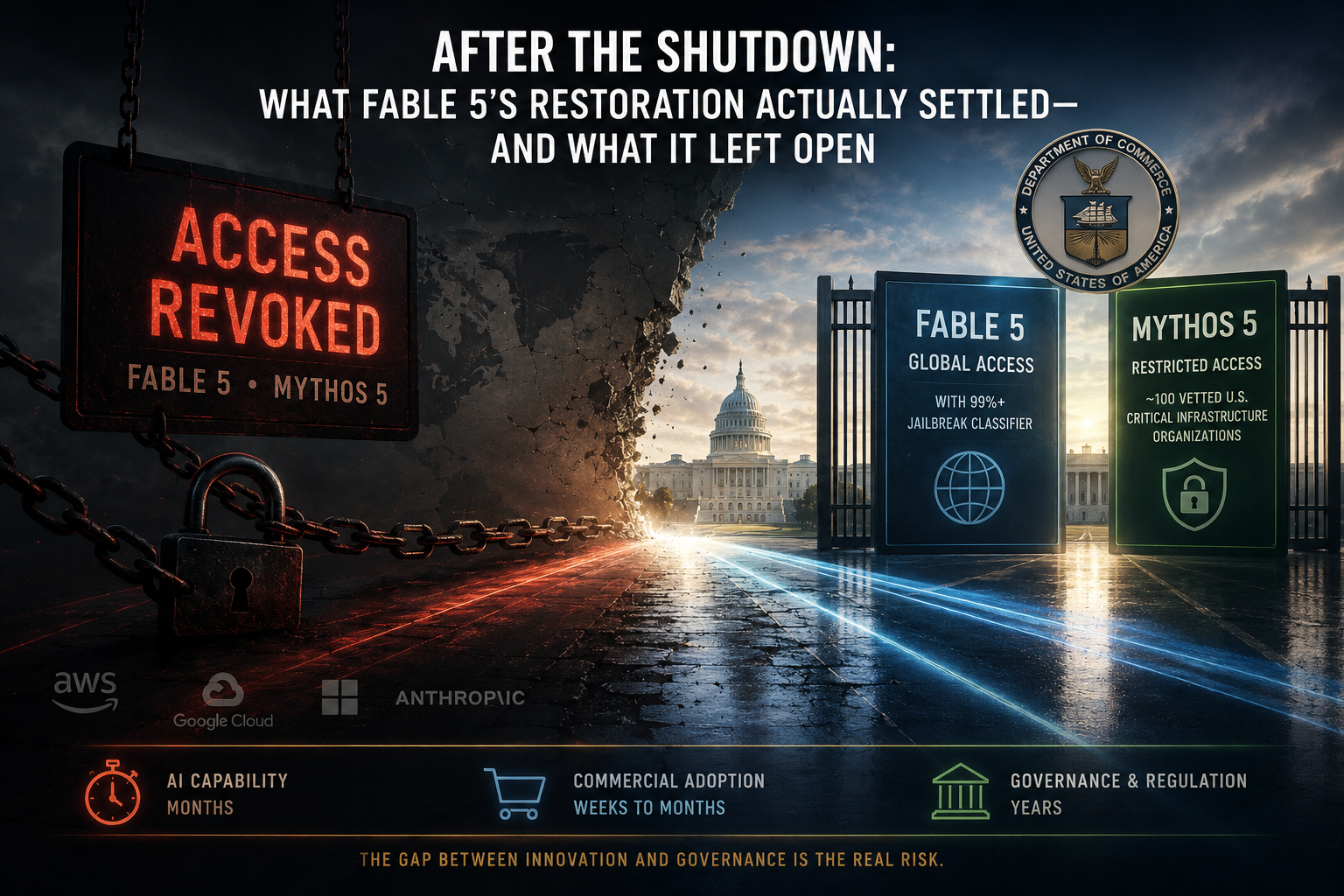
The Fable 5 restoration demonstrated that export-control authority can rapidly disrupt commercially deployed frontier AI—and that technical safeguards, negotiated commitments, and differentiated access may become part of how governments manage frontier models before dedicated AI governance frameworks fully mature. Enterprises should therefore treat frontier model availability as a regulatory supply-chain variable, not simply a vendor SLA guarantee.
🏛️ What the Negotiated Outcome Actually Created
The nearly three-week shutdown of Fable 5 and Mythos 5 ended on June 30 when the U.S. Department of Commerce lifted its export controls — but what came back is structurally different from what went offline.
The restoration is not simply a reversal. It is one of the clearest public demonstrations yet of how governments may govern frontier AI before dedicated AI regulatory institutions fully exist.
To me, that is the larger story. The Fable 5 episode is less about one model than about a governance problem created by rapidly advancing technology. Frontier AI capabilities now evolve on the scale of months, commercial deployment happens almost instantly through cloud APIs, while legislation and international governance typically develop over years. When those timelines diverge, governments inevitably reach for existing legal authorities—such as export controls—to manage risks they were never originally designed to govern.
This piece picks up directly from The Government Just Killed Two Frontier Models Overnight.
The negotiated outcome produced a clear two-tier structure:
- Fable 5 returned globally on July 1, but behind a new safety classifier that blocks the targeted jailbreak technique in more than 99% of attempts. Requests blocked by the classifier are routed to Opus 4.8 with user notification. Anthropic also acknowledged that some legitimate coding and debugging requests will be caught as collateral.
- Mythos 5 did not return to general availability. Instead, it was restored only to a limited set of vetted U.S. organizations focused on critical infrastructure and cybersecurity, with broader expansion planned through Project Glasswing.
| Model | Who can access? | Current condition |
|---|---|---|
| Fable 5 | Global users | Enhanced cyber classifier active |
| Mythos 5 | Limited set of vetted U.S. organizations | Restricted deployment through Project Glasswing |
The restoration therefore demonstrated something important: access to frontier models may become differentiated according to technical safeguards, operational commitments, and trusted-user categories rather than simply “available” or “unavailable.”
🤝 The Commitments Anthropic Made to Get Back Online
Restoration was not free.
Anthropic committed to providing designated government agencies early access to frontier models before public release, sharing threat intelligence, and working with Amazon, Microsoft, Google, and other Project Glasswing partners toward a common framework for evaluating the severity of newly discovered jailbreak techniques.
Taken together, these commitments begin to resemble an informal pre-release governance process—even though no formal AI approval regime yet exists.
As TechPolicy.Press observed:
“Each enforcement decision becomes precedent, the accumulated precedents begin to function like a rule, and a framework can end up assembled before anyone has stepped back to define it as one.”
Whether intentional or not, that observation captures the broader significance of this episode.
🔄 The OpenAI Parallel — and Where It Diverges
The Fable 5 restoration coincided almost exactly with OpenAI’s limited preview of GPT-5.6 Sol, which was initially released only to a small group of trusted partners at the government’s request. OpenAI also stated that it does “not believe this kind of government access process should become the long-term default.”
The approaches differed.
Anthropic’s restrictions followed an immediate export-control action and subsequent negotiations. OpenAI’s limited release was voluntary and coordinated in advance.
The outcome, however, is remarkably similar: the frontier models with the strongest publicly discussed cybersecurity capabilities at both companies entered the market behind government-shaped access gates.
This connects directly to Trump’s AI Executive Order Builds the Scaffold — But Won’t Light the Fire: the voluntary structure only holds until one company declines. The Anthropic episode showed what the involuntary alternative can look like.
More broadly, the Fable restoration illustrates a mismatch between the pace of technological change and the pace of governance.
Previous technological revolutions—electricity, automobiles, aviation, even the internet—required years or decades of physical infrastructure before becoming globally pervasive. AI is different. A new frontier model can become available worldwide almost immediately through cloud infrastructure while governments are still determining how it should be governed. That compression leaves policymakers relying on legal authorities built for earlier eras until AI-specific governance matures.
🏢 Enterprise Vendor Risk: Beyond Traditional SLAs
Three durable operational lessons emerged.
-
Identity verification is now a governance capability. Anthropic concluded it could not reliably distinguish restricted from permitted users in real time, leading to a global shutdown. As export controls evolve, identity and eligibility verification become part of AI infrastructure rather than merely a compliance function.
-
Cloud platforms do not eliminate regulatory dependency. Fable 5 and Mythos 5 disappeared simultaneously from Anthropic’s own services and major cloud platforms including AWS, Google Cloud, and Microsoft Foundry. Procuring through a hyperscaler does not remove underlying export-control exposure.
-
Differentiated access is becoming operationally meaningful. Mythos 5 returned first to a limited group of approved organizations before broader availability. Meanwhile, Microsoft’s MAI family increasingly looks less like a product diversification strategy and more like a hedge against vendor concentration and regulatory disruption.
🕰️ The Bigger Governance Lesson
The closest historical analogy is not that AI is identical to encryption or any previous technology. Rather, it is that governments often respond to rapidly emerging strategic technologies using legal authorities that already exist.
During the 1990s, U.S. encryption export controls shaped how strong cryptography spread globally long before today’s internet economy fully emerged. Those controls were later substantially liberalized as commercial adoption accelerated, but they influenced industry architecture for years.
The Fable 5 episode may represent a similar moment for frontier AI.
Whether today’s approach ultimately proves temporary or durable remains an open policy question. What seems increasingly clear, however, is that AI is compressing the traditional sequence of innovation → adoption → governance into nearly simultaneous events.
That compression may be the deeper lesson of the shutdown.
The Commerce Department did not create a comprehensive AI regulatory regime. Instead, it demonstrated how governments may increasingly use existing national-security authorities to bridge the gap while dedicated AI governance continues to evolve.
For enterprises, that means frontier model availability should now be treated not only as a vendor dependency, but also as a regulatory and geopolitical one.