Anthropic's 40% Enterprise Share Is a Governance Fact Now, Not a Market Story
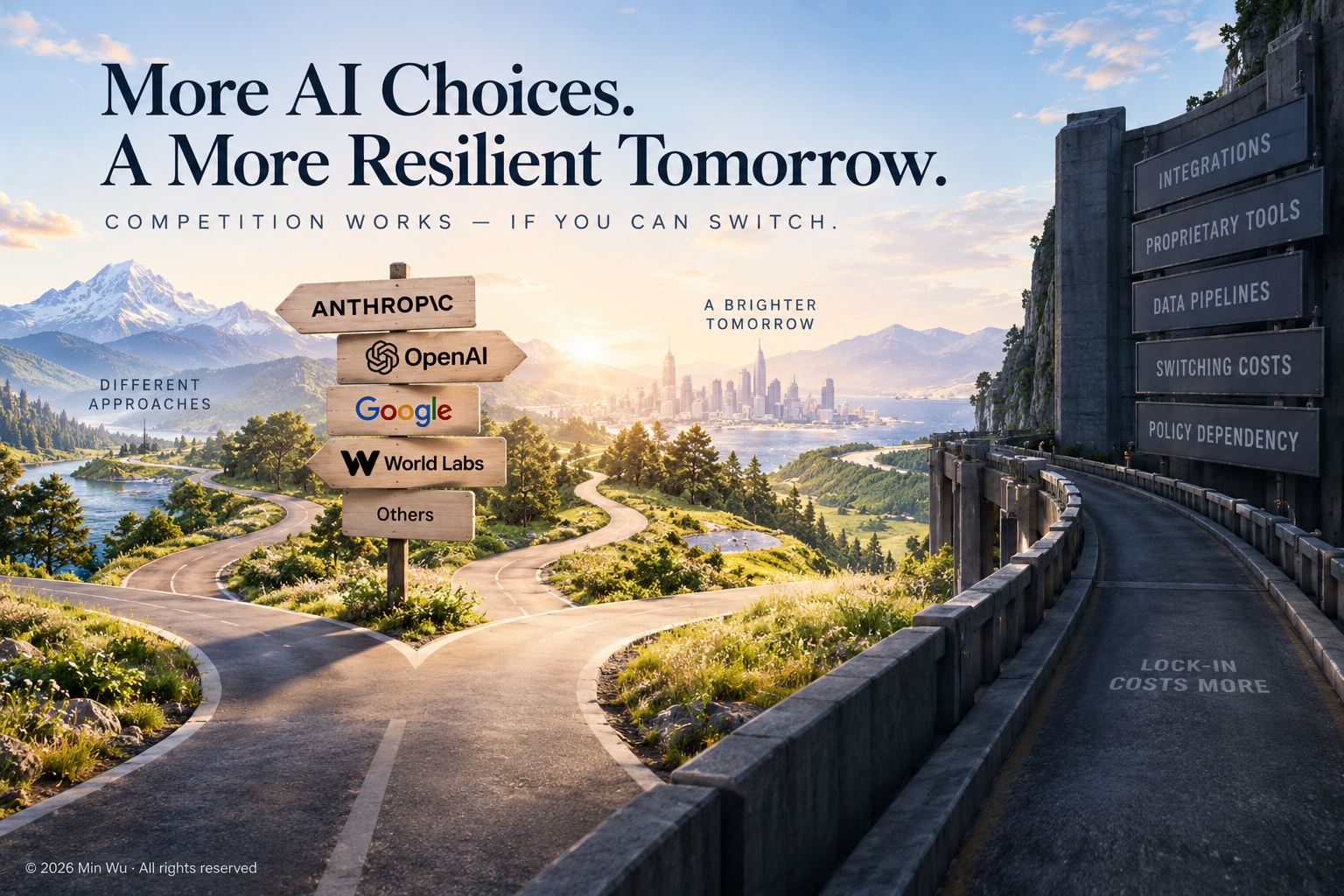
The risk is not that Anthropic has 40% of enterprise LLM API usage. It is that model choice increasingly determines retention, safeguards, monitoring, tool architecture, and operational dependencies. Healthy model competition only protects enterprise buyers if they remain capable of changing providers.
🏁 The Model Race Is Getting Broader — While Enterprise Usage Concentrates
September opened with another burst of frontier-model releases.
Anthropic introduced Claude Fable 5.1, extending its push into coding, knowledge work, and long-running agentic workloads. OpenAI followed with GPT-6 Astra, built for coding, research, computer use, and complex multi-step work — and the first OpenAI model to reach the company’s Critical cybersecurity capability threshold. Fei-Fei Li’s World Labs, meanwhile, released Atlas, an omni world model that operates across text, images, video, and 3D to reconstruct and simulate spatial worlds.
These are not three versions of the same product.
They point toward an AI frontier that is becoming more diverse: language and reasoning models, computer-using agents, cyber-capable systems, and world models designed to understand physical environments.
That competition is healthy.
But underneath it sits an interesting tension:
The model frontier is diversifying at the same time that enterprise production usage is concentrating.
📊 The 40% Number Is More Than a Market Story
Menlo Ventures’ latest State of Generative AI in the Enterprise estimates that Anthropic now accounts for 40% of enterprise LLM API usage, up from 24% in 2024 and 12% in 2023. OpenAI fell from 50% in 2023 to 27%, while Google climbed to 21%.
The numbers are estimates based on survey-reported production usage weighted by application scale, not audited vendor revenue. But the direction is striking.
The split is even more pronounced in coding: Menlo estimates Anthropic at 54%, versus 21% for OpenAI. Coding itself reached roughly $4 billion in enterprise spending in 2025 — 55% of departmental AI spend.
Coding appears to have been Anthropic’s enterprise wedge. Claude’s sustained performance in software engineering, followed by Claude Code, helped establish the provider deeply inside production workflows.
Most coverage naturally treats this as a competitive story: Anthropic gaining, OpenAI losing, Google catching up.
For governance teams, the more consequential question is different:
What happens when a large share of enterprise AI infrastructure becomes operationally dependent on one provider?
A 40% share is not inherently a problem. It may simply mean enterprises currently prefer Anthropic’s products.
The risk begins when concentration combines with switching costs.
🔒 Model Choice Is Becoming Architecture Choice
Early LLM APIs encouraged a comforting assumption: models were largely substitutable.
Change the endpoint. Adjust the prompts. Rerun the evaluations. Move on.
That assumption becomes weaker as AI systems become more sophisticated.
Enterprises increasingly build around provider-specific context behavior, caching, tool interfaces, agent harnesses, observability, evaluations, security controls, data architecture, and operational expertise.
Fable 5.1 makes this unusually visible.
Anthropic says using Fable requires 30-day data retention by default for safety monitoring. Eligible enterprise customers can temporarily use zero data retention while Anthropic rolls out its new Enterprise Frontier Safeguards architecture.
Under EFS, data will instead reside in customer-controlled cloud infrastructure, and human review will by default be performed by the customer rather than Anthropic.
That means adopting a frontier model can now change decisions around data retention, privacy architecture, human review, security monitoring, and internal governance responsibilities.
Model choice is increasingly becoming governance-architecture choice.
OpenAI’s Astra illustrates the same phenomenon from another direction. Because Astra reaches OpenAI’s Critical cybersecurity capability threshold, OpenAI has surrounded it with stronger deployment, security, and monitoring controls.
Frontier models increasingly arrive not just with different benchmark scores, but with different control environments attached to them.
🤖 The Agent-Washing Finding Makes This More Immediate
The same Menlo report contains another revealing number.
Only 16% of enterprise deployments and 27% of startup deployments qualify as true agents — systems where an LLM plans and executes actions, observes feedback, and adapts its behavior.
Most production architectures remain closer to fixed-sequence or routing-based workflows wrapped around model calls.
Governance teams are rightly preparing for autonomous systems capable of planning, tool use, and emergent behavior — the class of systems I discussed in Agentic AI Has Outrun the Governance Playbook.
But that 16% figure means emerging autonomy risks should not obscure a much more widely distributed exposure already embedded across production systems:
provider dependency.
The majority of today’s enterprise AI estate may not yet consist of genuinely autonomous agents. But those systems can still depend on the same APIs, security policies, retention rules, deployment infrastructure, and model lifecycle decisions.
Autonomy risk grows with what the system can do.
Concentration risk grows with how much of the organization depends on the same provider.
⚠️ The Pentagon Episode Shows What Dependency Can Look Like
The U.S. government’s dispute with Anthropic provides an unusually visible example of how forces outside model performance can affect provider access.
Earlier this year, the Department of Defense designated Anthropic a supply-chain risk following a dispute over permitted uses of Claude, including autonomous weapons and domestic surveillance.
In August, a federal judge ruled the Pentagon’s actions unlawful, finding constitutional and statutory problems with the designation.
Yet even that did not produce a clean operational resolution. On September 3, a senior Pentagon technology official said Anthropic remained designated a supply-chain risk to the defense industrial base, despite other administration officials signaling improving relations with the company.
The merits of that political and legal dispute are not the point here.
The operational lesson is simpler:
Provider availability can change for reasons that have nothing to do with model performance or the quality of your implementation.
Government policy can change. Safety policies can change. Retention requirements can change. Commercial terms can change. Models can be deprecated.
The relevant question for an enterprise is therefore not whether its preferred provider is trustworthy today.
It is whether the organization could continue operating if the relationship changed tomorrow.
🔄 The Real Governance Question: Can You Leave?
Enterprise technology has seen this pattern before.
A product wins because it is good. Adoption creates integrations. Integrations create ecosystems. Ecosystems create organizational expertise. Architecture and expertise then create switching costs.
Eventually, an organization can become unhappy with a platform while discovering that replacing it costs more than continuing to use it.
AI does not have to repeat that history.
In principle, LLMs should be more portable than many traditional enterprise platforms. They are accessed through APIs, competing providers expose increasingly similar capabilities, and orchestration layers can abstract parts of the underlying model.
But agentic AI can push in the opposite direction.
Provider-specific tool APIs, computer-use interfaces, context-management strategies, caching, safety controls, evaluations, and proprietary agent infrastructure can progressively make sophisticated systems less interchangeable.
That is why the relevant governance control is not multi-vendor for its own sake.
It is credible portability.
🛡️ Portability Should Become an AI-Governance Control
Enterprises do not necessarily need two frontier providers running every workload simultaneously.
But for critical AI systems, governance teams should periodically ask:
- Can this workload run on another model?
- What functionality would break?
- Which prompts, tools, evaluations, and safeguards would need rebuilding?
- Would another provider change our privacy or retention obligations?
- How long would migration realistically take?
- Do we have an acceptable degraded mode if the primary provider becomes unavailable?
These questions turn portability from an architectural preference into a resilience control.
And Menlo’s own earlier research contains an interesting warning sign: although builders frequently upgrade to newer models from the same provider, only 11% switched vendors in its mid-2025 survey.
That does not prove lock-in. But it is exactly the behavior governance teams should watch as AI platforms accumulate more surrounding infrastructure.
The objective is not to avoid choosing today’s best model. It is to avoid making today’s best model impossible to replace tomorrow.
🌐 Healthy Competition Requires the Ability to Choose Again
The arrival of Fable 5.1, Astra, and Atlas is encouraging precisely because they are different.
Anthropic is pushing deeper into coding and agentic knowledge work while developing its own enterprise safeguard architecture. OpenAI is advancing computer use and high-capability cybersecurity. World Labs is pursuing spatial intelligence and world modeling rather than simply another language model.
The frontier is branching.
That is exactly the kind of competition enterprise buyers should want.
But competition at the research frontier only protects customers if competition remains viable after deployment.
If changing providers eventually requires rebuilding an organization’s agent architecture, evaluation infrastructure, security controls, data-governance processes, and operational workflows, having five excellent frontier labs matters surprisingly little to an enterprise effectively trapped inside one ecosystem.
That is why Anthropic’s estimated 40% share is becoming a governance fact rather than merely a market story.
The concern is not that Anthropic is winning.
The concern would be the same if OpenAI, Google, or another provider eventually occupied the same position.
Healthy AI competition depends not only on having multiple frontier models. It depends on enterprises preserving the ability to choose among them again later.