Anthropic's Economic Scenario Explorer Turns AI Labor Forecasting Into Something You Can Argue With
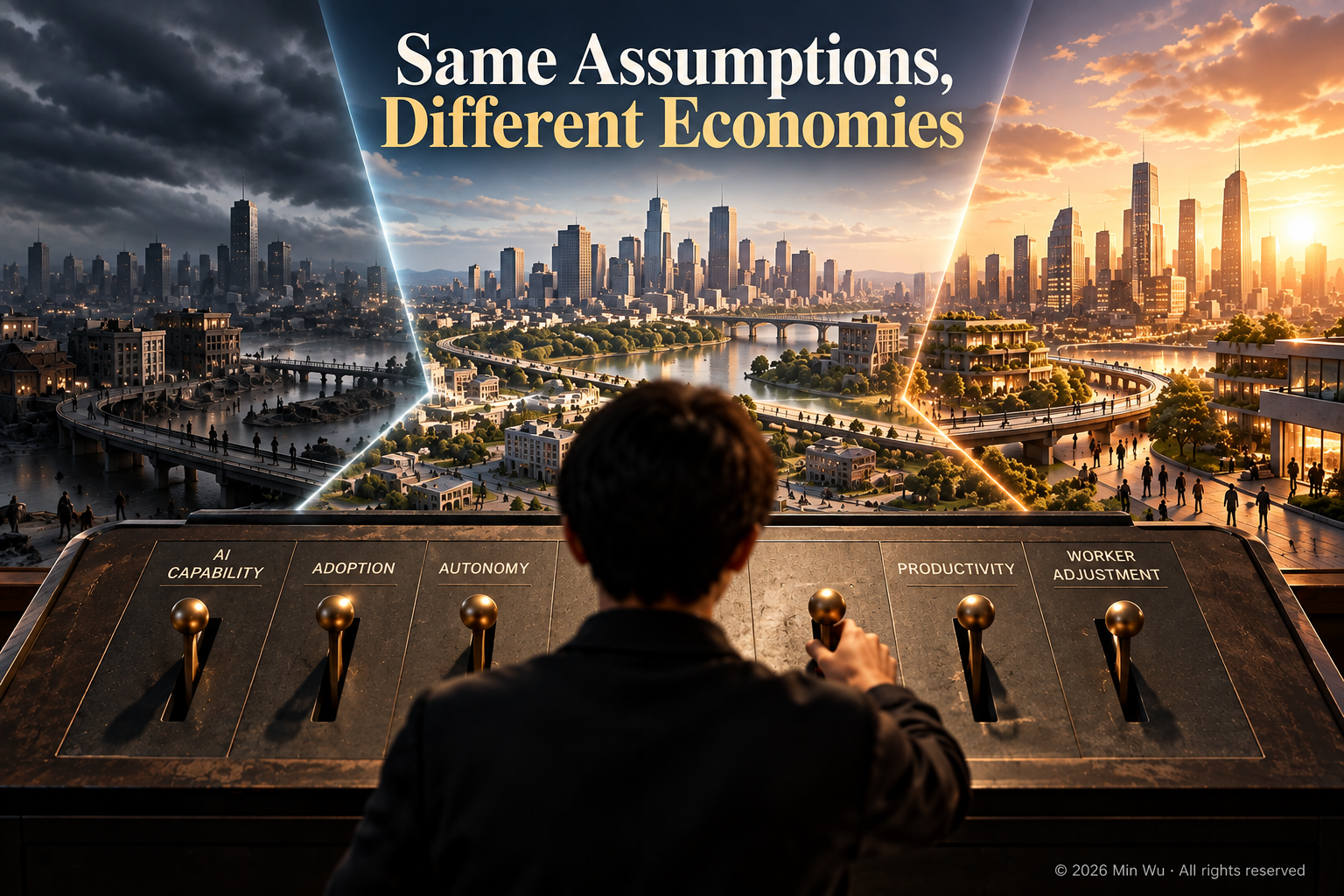
The Econ Scenario Explorer's real innovation isn't its GDP range (1.6%–32.4% by 2030) but its task-based, parameter-explicit architecture — a design template that makes assumptions contestable rather than a forecast to be believed, and one every lab and regulator building an economic case for or against AI policy will now have to reckon with.
📊 The headline number is the least interesting part
On September 9, Anthropic’s Economics team released the Econ Scenario Explorer, an interactive tool for exploring three possible paths for the US economy through 2030 — modest, substantial, and extreme — built on a companion technical report, Economic Scenarios for Transformative AI, and a survey of 10,980 US adults.
The topline range is enormous. GDP ends 2030 anywhere from 1.6% above a no-AI baseline in the modest case to 32.4% above it in the extreme case. In the extreme scenario, unemployment among cognitive workers reaches 17.9%, while their wages fall 11.5% relative to the no-AI path.
Those numbers will generate headlines. But they aren’t the most interesting part.
The real contribution is architectural: Anthropic built a model whose critical assumptions are exposed for users to change rather than buried inside a single forecast.
Anthropic explicitly says the scenarios are not predictions and carry no attached probabilities. The point is not to tell us what the economy will look like in 2030. It is to ask a more useful question: if you believe these things about AI capability, adoption, autonomy, productivity, and worker adjustment, what kind of economy follows?
That distinction matters.
🧩 Tasks, not titles
The model starts with a task-based decomposition drawn from the Department of Labor’s O*NET taxonomy, rather than treating an occupation as a single unit.
Job titles are politically legible but economically crude.
A nurse performs many different tasks. AI might help draft discharge instructions and assist with remote patient monitoring, but it cannot bathe a patient. Some tasks can therefore be augmented, some automated, and others remain human.
Anthropic’s model also allows new human tasks to enter the bundle as existing tasks are automated. That’s important because occupations don’t simply lose tasks as technology advances. They change.
This task-level approach builds on Anthropic’s earlier Claude usage study, which mapped roughly a million Claude conversations onto O*NET tasks and found AI usage particularly concentrated in areas such as software development and writing.
But there is a limitation.
O*NET describes the occupational structure we know today. Anthropic’s economic model can mathematically represent future human tasks through a “reinstatement” parameter, but it cannot know what those tasks will actually be, which occupations will contain them, or what entirely new occupations might emerge.
The framework can model the existence of future work more easily than it can model the nature of that work.
That’s a meaningful constraint when the thing being forecast is structural economic change.
🔬 Anthropic is measuring an economy its own models are changing
Why does an AI lab have an economics team in the first place?
Because Anthropic isn’t merely studying an external technology called AI. It is building one of the technologies whose economic consequences it is trying to measure.
That gives it something conventional economic forecasters don’t have: first-party evidence about how people actually use a frontier model.
Anthropic’s Economic Index uses privacy-preserving analysis of Claude activity to examine which occupational tasks people delegate to AI, which they perform collaboratively with it, and how those patterns change as the technology becomes more capable.
The progression is increasingly clear:
Claude usage → observed tasks → labor exposure → productivity and displacement → economy-wide scenarios.
That’s potentially powerful. Instead of beginning entirely with assumptions about what AI might automate, Anthropic can compare those assumptions with evidence about what one frontier AI system is already being asked to do.
But the same advantage creates an important limitation.
Claude usage is not the economy.
Anthropic observes users of its own products and APIs, not a representative sample of all workers, firms, AI systems, or economic activity. Its telemetry gives the company an unusually detailed window into AI adoption — but it remains a window.
🎛️ Five questions, not one forecast
The public Explorer turns a sprawling debate about AI and labor into five user-facing questions:
What can AI do? How widely will it be adopted? How autonomous will it become? How much productivity will it create? And how quickly can displaced workers find new work?
That separation is more important than it looks.
A claim such as “AI will add $X trillion to GDP” invites people either to believe the number or reject it.
Anthropic’s structure instead makes disagreement specific.
You can believe frontier models will become extraordinarily capable while thinking enterprise adoption will remain slow. You can expect rapid adoption but limited autonomous execution. Or you can accept both while arguing that workers will move into new tasks much faster than the model assumes.
The disagreement becomes which assumption is wrong, rather than whether one giant forecast is right.
Anton Korinek, who led the project, described it as a framework for comparing possibilities, which is a better way to understand the Explorer than as another attempt to predict 2030.
⚖️ Change one assumption, change the economy
The technical report contains an example that makes the point better than the headline GDP numbers do.
Under Anthropic’s extreme scenario, the baseline model produces an 11.5% decline in cognitive-worker wages and 17.9% cognitive-worker unemployment.
Change assumptions about wage adjustment, however, and radically different labor markets emerge.
One specification produces roughly a 42% wage decline but only 2.6% unemployment. Another produces slightly higher wages but approximately 24% unemployment.
The assumed AI capability hasn’t changed.
The labor-market assumption has.
That’s the strongest demonstration of why the Explorer is more useful as an argument framework than as a forecast.
“AI causes 18% knowledge-worker unemployment” sounds like a prediction about technology. Anthropic’s own sensitivity analysis shows that it is also a claim about wages, hiring, job search, and how labor markets absorb technological change.
Making those assumptions visible doesn’t solve the uncertainty.
It makes the uncertainty inspectable.
⚠️ Transparent doesn’t mean realistic
That distinction matters because the model is deliberately coarse.
Anthropic divides workers into broad groups, does not follow individual workers through displacement, and leaves out mechanisms including policy responses, business cycles, some aggregate-demand effects, financial disruption, and catastrophic risks.
External economists reviewing an earlier draft raised additional questions. Some challenged the assumption that occupations heavily exposed to AI must necessarily shrink. Some regarded the extreme scenario more as a thought experiment than a plausible central case. Others argued that AI could accelerate technological progress in ways the framework still understates.
Anthropic also makes clear that outside reviewers — including Daron Acemoglu, David Autor, Ben Jones and others — were not asked to endorse its conclusions.
So the Explorer shouldn’t be mistaken for a more sophisticated crystal ball.
Its advantage is almost the opposite:
The assumptions are unusually visible, while the economy underneath them remains deliberately simplified.
Transparency doesn’t make the model right. It makes it easier to identify exactly where it might be wrong.
🏛️ The governance value is in the argument
Economic forecasts increasingly enter arguments about AI policy.
AI companies can point to productivity and GDP gains when making the case for deployment. Labor advocates can point to displacement. Governments have to decide whether retraining, education reform, income support, taxation, or other interventions are warranted long before anyone knows which technological trajectory will actually materialize.
A single forecast hides much of that disagreement inside the model.
A scenario architecture exposes it.
That’s why Anthropic’s most consequential contribution here may not be its estimate that AI could make the US economy 32.4% larger than a no-AI baseline by 2030.
It’s the decision to say:
Here are the assumptions. Change them yourself. See what happens.
That is a useful design principle beyond economic forecasting.
AI governance increasingly has to operate under uncertainty that cannot simply be modeled away. In those situations, the best analytical tool may not be the one that produces the most authoritative number.
It may be the one that makes everyone explain why their number is different.