China's AI Companion Rules Are Live — and the Compliance Crackdown Had Already Begun
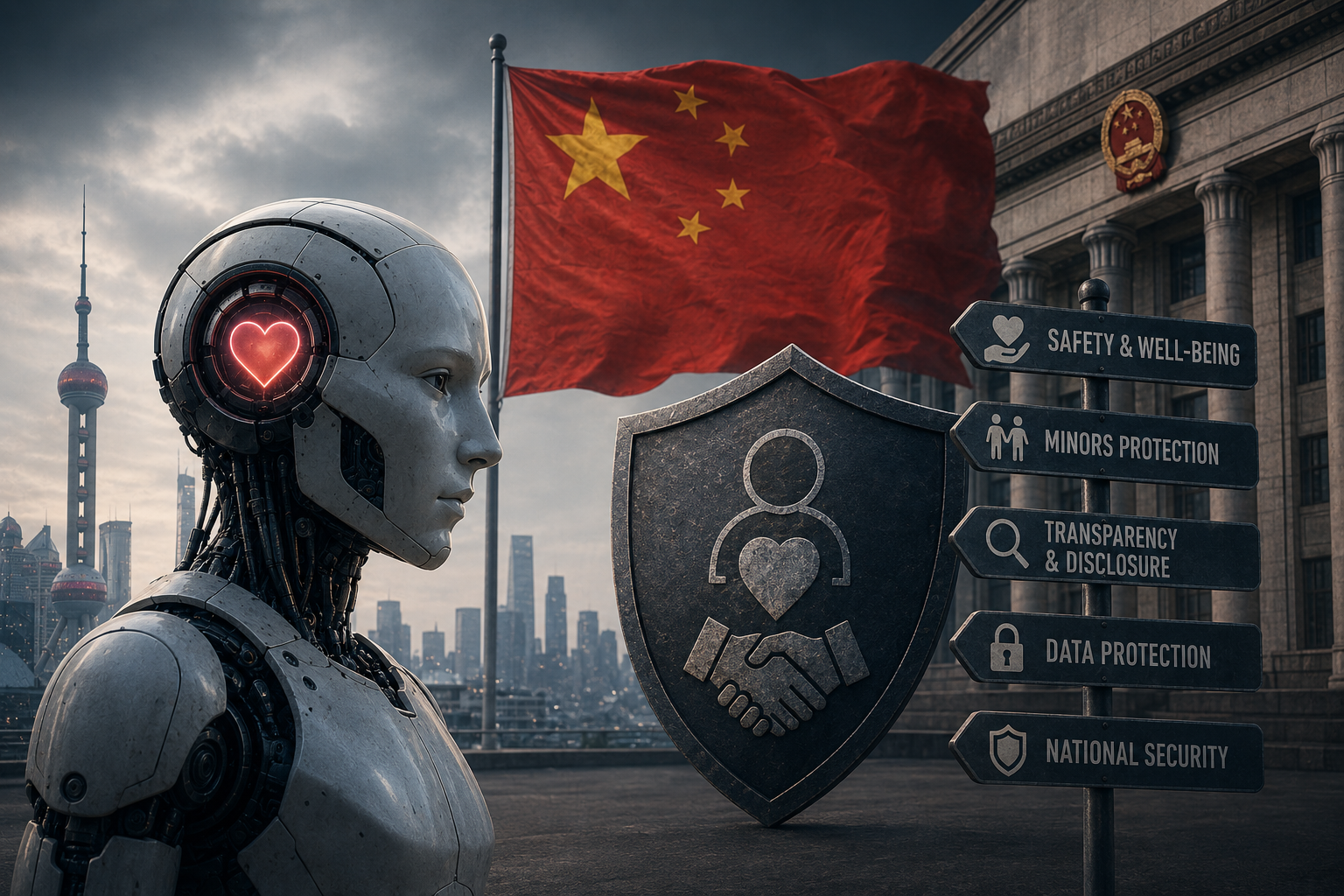
China's dedicated framework for AI companion services is now in force. For providers serving users in China, the decisive compliance questions increasingly sit in product architecture: persistent personas, long-term memory, emotional engagement, and runtime safeguards have become regulatory risk surfaces rather than optional product features.
📜 What the Rules Actually Say
China’s Interim Measures for the Administration of AI Anthropomorphic Interaction Services, jointly issued by five central government authorities on April 10, 2026, took effect on July 15, 2026. They establish what appears to be the first dedicated national regulatory framework governing AI services designed for sustained emotional interaction.
The Measures cover services that simulate human personality and maintain continuous emotional relationships with users — encompassing products such as AI companions, virtual partners, and other persona-based interactive systems. By contrast, customer-service bots, knowledge Q&A systems, workplace assistants, and educational tools remain outside the framework provided they do not engage in continuous emotional interaction.
Providers launching covered services must complete the applicable algorithm-filing procedures and security assessment requirements, clearly disclose that users are interacting with AI, implement safeguards against emotional dependency, provide intervention pathways where users show signs of self-harm or acute distress, protect minors, and generally may not use users’ sensitive interaction data for model training without separate consent. The Measures also prohibit virtual intimate-relationship services for minors.
The jurisdictional hook is practical rather than corporate: serving users in China, not where the provider is incorporated.
The companion/productivity divide therefore becomes the central compliance question. A chatbot designed simply to answer questions is regulated very differently from one designed to cultivate an ongoing emotional relationship.
🚨 The Compliance Crackdown Had Already Begun
Although the Measures only became effective on July 15, China’s AI enforcement environment was already active under existing algorithm, generative AI, and platform-governance rules. Chinese authorities had been conducting campaigns against non-compliant AI services well before the new framework formally took effect.
The industry’s response was equally telling. ByteDance’s Doubao and Alibaba’s Qwen both announced that their AI agent creation features would be discontinued on July 15, while Tencent had already removed a similar Yuanbao feature in late June. Doubao redirected users to ByteDance’s dedicated companion application Maoxiang, while Qwen warned users to export important agent configurations before the shutdown.
Neither company publicly attributed these decisions directly to the new Measures. Nevertheless, the timing strongly suggests that broad user-created agent ecosystems had become significantly more difficult to operate under the emerging regulatory environment.
The compliance lesson is architectural, not procedural. In practice, persistent personas, long-term memory, accumulated relationship history, and emotionally engaging interaction become regulatory risk surfaces because they determine whether a product crosses into continuous anthropomorphic interaction. These are not features that can simply be switched on or off after launch.
⚖️ Three Frameworks in One
It is tempting to read these Measures as consumer-protection rules. They are considerably broader.
| Dimension | Mechanism |
|---|---|
| Consumer protection | Dependency safeguards, crisis intervention, protections for minors, consent for sensitive data use |
| AI governance | Algorithm filing, security assessment, transparency obligations |
| State & national-security governance | Content controls, public-interest provisions, CAC oversight |
The third dimension is particularly noteworthy.
As the Foundation for Defense of Democracies observed in its July analysis, China is treating AI companions not simply as consumer software but as technologies capable of shaping long-term beliefs and behaviour through sustained emotional relationships. That recognition is important. At the same time, China’s framework combines genuine user-protection measures with content-control and national-security provisions that answer to the state rather than the individual.
Few democratic jurisdictions are likely to adopt that model wholesale. But the underlying observation—that emotionally relational AI creates governance risks distinct from ordinary chatbots—is increasingly difficult to dismiss.
🤝 Relationship-Building Has Become a Regulatory Category
The most important insight behind these Measures is not any individual compliance obligation.
It is the recognition that relationship-building itself has become an AI capability.
Traditional AI governance focuses primarily on outputs:
- Did the model generate harmful content?
- Was it biased?
- Did it hallucinate?
China’s framework asks a different question:
What happens when an AI system develops an ongoing relationship with the same person over weeks or months?
Persistent memory, emotional affirmation, evolving personas, and accumulated relationship history can gradually create dependency and influence that a single conversation cannot.
This is precisely why the regulations draw a distinction between productivity assistants and companion systems. The governance concern is no longer just what the model says in one response, but how the relationship develops over time.
That observation extends well beyond China.
California’s SB 243, which took effect earlier this year, similarly recognises that companion chatbots require safeguards beyond ordinary AI disclosure, although its approach remains far narrower than China’s. Meanwhile, neither the U.S. federal government nor the EU AI Act currently provides a comprehensive framework governing persistent emotional relationships between users and AI systems.
🔍 The Grey Zone That Will Drive the Next Compliance Wave
The Measures deliberately avoid specifying any technical threshold for when an assistant becomes an AI companion.
How much memory is too much?
How much rapport becomes emotional dependency?
When does a helpful assistant become a relationship?
Those questions remain unanswered—and that uncertainty may explain why broad AI agent platforms became increasingly difficult to justify under the new regulatory environment.
This connects directly to the broader governance challenge discussed in Agentic AI Has Outrun the Governance Playbook. As AI systems accumulate context, remember users across sessions, and adapt emotionally over time, they cross boundaries that traditional AI governance frameworks were never designed to monitor.
China’s Measures make that transition a legal classification rather than simply a product-design choice.
🔭 What to Watch
My read: China did not introduce these Measures simply because chatbots became more capable. It acted because relationship-building itself has become a form of AI capability—and therefore a source of regulatory concern.
For providers serving Chinese users, compliance increasingly depends on product architecture rather than disclosure alone. Many foreign providers may ultimately face three realistic choices: build a dedicated China-specific product, remove companion functionality altogether, or exit that segment of the market.
For Western regulators, the political model is unlikely to be replicated. China’s framework is inseparable from its broader system of state oversight and content governance. Nevertheless, it identifies a genuine governance gap that remains largely unresolved elsewhere.
As frontier AI becomes increasingly persistent, personalised, and emotionally engaging, the central governance question may no longer be what AI knows, but how AI builds relationships.