Entropy, Evolution, and AI: A Personal Reflection on Order
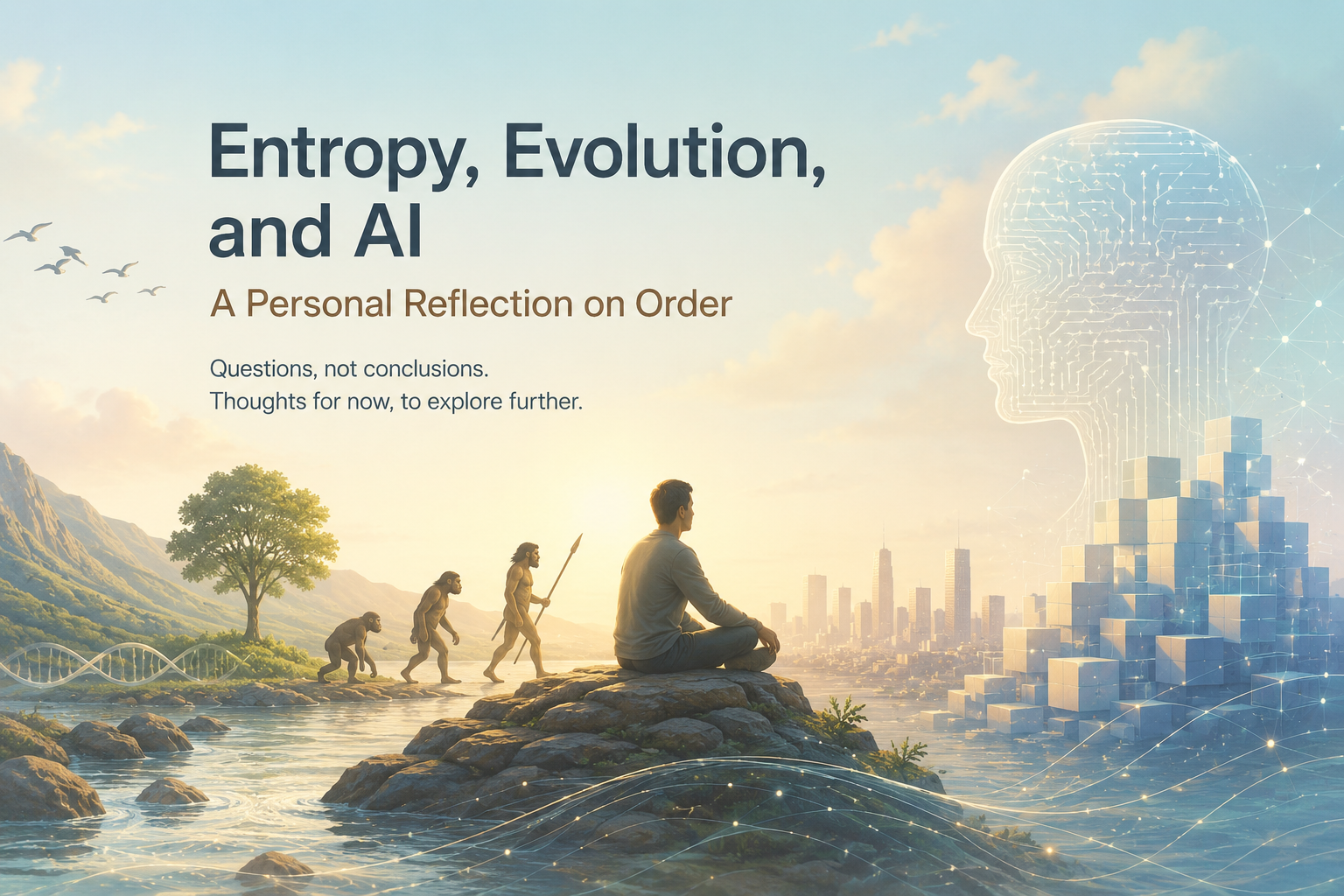
The more I think about entropy, evolution, and AI, the less certain I become that 'order' and 'disorder' are opposites. Perhaps they are simply different perspectives on the same process.
This is not an argument or a conclusion. It is simply a snapshot of my current thinking. I suspect many of these ideas have been explored before by scientists and philosophers far more deeply than I have. My goal here is merely to record the questions that seem worth returning to.
Most people have heard some version of the Second Law of Thermodynamics: entropy tends to increase. Popularly stated, the universe tends toward greater disorder.
Yet when I look around, I see something that appears almost opposite.
Stars form from diffuse gas. Life emerges from chemistry. Organisms become astonishingly organized. Human societies build institutions, cities, languages, sciences, and technologies. Today we are even building AI systems that increasingly resemble certain aspects of human cognition.
If entropy always increases, why does the universe seem so good at creating order?
Of course, physics already has an answer. The Second Law applies to the total entropy of an isolated system, not necessarily to every local part of it. The Earth continually receives low-entropy energy from the Sun while radiating higher-entropy heat into space. Local order can emerge while total entropy still increases. Physicists such as Ilya Prigogine, whose work on dissipative structures earned the 1977 Nobel Prize, explored how highly organized systems can emerge and persist precisely because energy continuously flows through them rather than despite it.
That resolves the apparent contradiction in physics.
But it leaves me wondering whether there is a broader philosophical lesson.
🌱 Evolution Does Not Seek “Better”
When people speak about evolution, we often unconsciously attach words like progress, improvement, or perfection.
Darwin’s theory does not.
Natural selection simply favors what reproduces successfully under particular environmental conditions. There is no universal notion of “better.” There is only better adapted to a particular environment at a particular time.
That distinction feels surprisingly relevant beyond biology.
Many of us pursue what we believe to be success—or what society tells us success should look like. We create careers, companies, reputations, and increasingly sophisticated technologies.
Perhaps that is perfectly natural.
But I wonder whether adaptation is actually our default state.
When we are young, inexperienced, or lacking resources, we constantly adapt. We observe, imitate, compromise, and learn. Survival itself demands responsiveness to the environment.
As we gain resources, influence, or expertise, we become increasingly capable of shaping our surroundings instead of merely responding to them.
That, too, is adaptation.
But perhaps it also carries a subtle risk: believing that because we can shape our environment, we no longer need to adapt to it.
🏛️ Every Order Has a Cost
Creating order is never free.
A healthy body requires continuous energy.
A successful company requires continuous coordination.
A scientific theory requires continuous testing.
Even civilizations require enormous effort simply to maintain themselves.
Perhaps every form of order is maintained by exporting entropy elsewhere—not only in the physical sense through energy consumption, but metaphorically through opportunity costs, uncertainty, maintenance, and unintended consequences.
The question may not be whether we should create order.
Perhaps the more interesting question is:
Which forms of order are worth continuously paying for?
🤖 AI: Adaptation or Imposition?
AI makes this question even more interesting.
At first glance, frontier AI models seem like the ultimate example of imposed order.
We intentionally design algorithms, architectures, training procedures, safety systems, and evaluation frameworks. Training a large model consumes enormous computational resources to produce an intricate structure capable of processing language, images, and increasingly complex tasks.
But stepping back, another perspective emerges.
Humans evolved.
Human intelligence evolved.
Technology is a product of that intelligence.
If humans are themselves products of natural evolution, perhaps AI is not something outside nature but one more expression of nature organizing itself through human beings.
Beavers build dams.
Spiders build webs.
Humans build neural networks.
The mechanisms differ, but perhaps the continuity deserves more attention than the distinction.
Whether AI represents adaptation, imposed order, or both remains an open question in my mind.
🎬 A Thought Experiment from Breaking Bad
This thought experiment came to mind while reflecting on the television series Breaking Bad.
Walter White creates something remarkably organized—not just the famous blue methamphetamine, but eventually an entire production, logistics, and distribution network.
Objectively, it is an impressive system.

Yet society rightly condemns it because it produces profound harm.
So should we describe it as “adaptive”?
One answer is no. It violates laws, destroys lives, and ultimately proves unsustainable.
Another answer is yes—at least temporarily. It satisfied demand, attracted participants, generated incentives, and persisted for a time because it fit certain economic and social conditions.
Neither answer feels entirely satisfactory.
Perhaps this illustrates an important distinction between describing and evaluating.
Something can emerge because it fits certain conditions without implying that it is morally desirable.
Evolution explains persistence, not virtue.
Fitness is not the same as goodness.
📚 A Thought Worth Revisiting
As I reflected on these questions, I realized many thinkers have approached parts of them from different directions.
Charles Darwin emphasized adaptation rather than progress in On the Origin of Species.
Ilya Prigogine explored how ordered structures emerge far from thermodynamic equilibrium.
The economist and complexity scientist Friedrich Hayek argued in The Fatal Conceit that many social institutions are products of spontaneous order rather than centralized design.
The philosopher Laozi, in the Tao Te Ching, repeatedly cautioned against forcing the world to conform to our desires, suggesting instead that wisdom lies in understanding and moving with underlying patterns rather than against them.
These ideas are not identical.
But they seem to orbit a common question:
Is lasting order something we construct, something we discover, or something that emerges between ourselves and our environment?
I don’t know the answer.
Perhaps there isn’t a single answer.
For now, I simply find myself asking whether the most successful forms of order—from organisms to civilizations to AI—are less about defeating nature than about fitting within larger systems whose rules we only partially understand.
That seems like a worthwhile question to keep exploring.