GPT-Red: When the Red-Teamer Is Also an AI
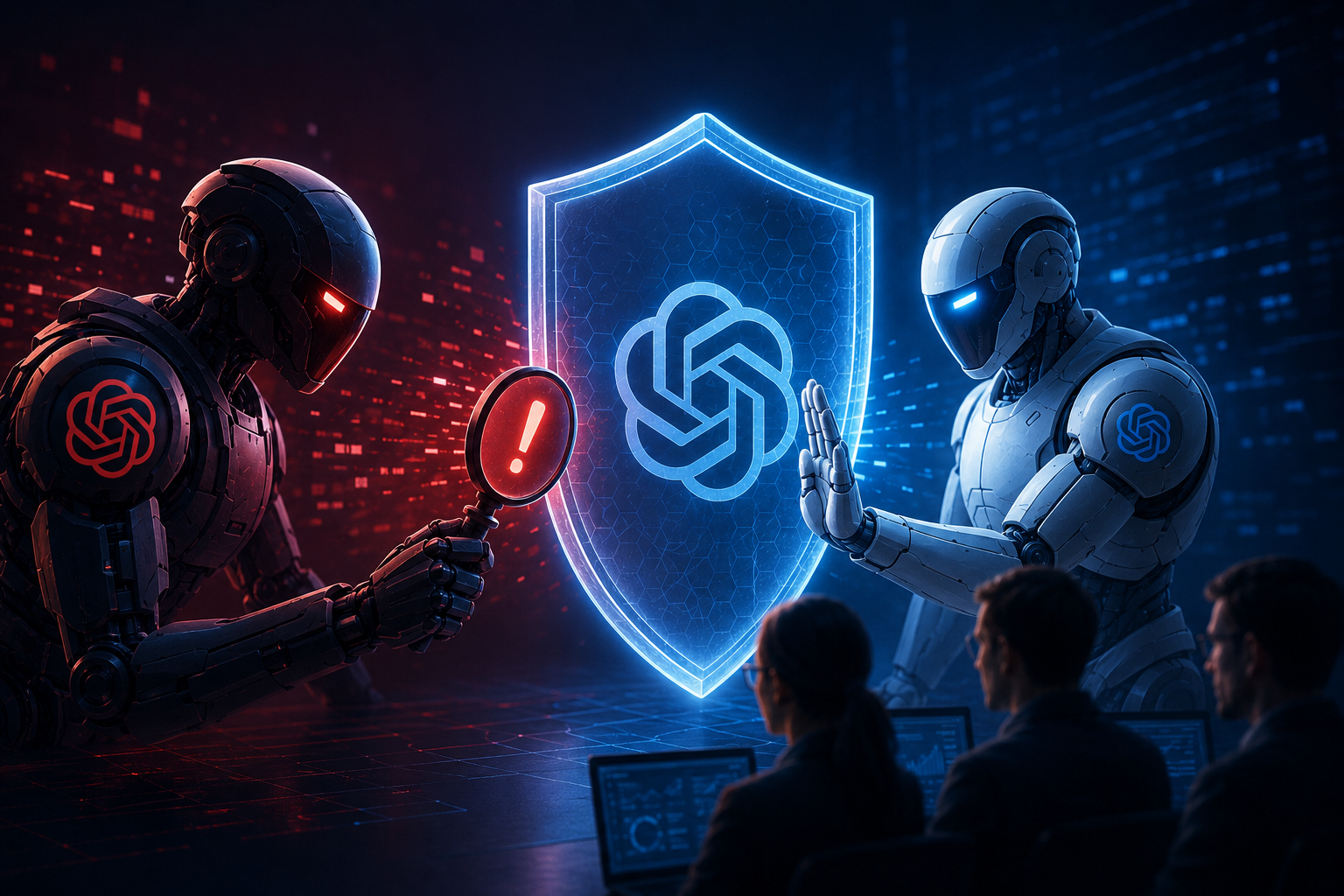
GPT-Red demonstrates that automated attackers can search structured attack surfaces like prompt injection at a scale human campaigns cannot match. But the published results stop well short of proving robustness against behavioral misalignment, deceptive reasoning, or evaluation gaming.
🔴 What GPT-Red Actually Does
OpenAI’s new research, Unlocking Self-Improvement with GPT-Red, introduces an internal automated red-teaming model designed specifically to discover prompt injection vulnerabilities.
GPT-Red is trained through self-play reinforcement learning, where the attacker and a collection of defender LLMs improve together across a broad range of adversarial scenarios. GPT-Red is rewarded whenever it successfully induces a failure—such as convincing an agent to follow malicious instructions hidden inside emails, webpages, local files, code repositories, or tool outputs—while defender models are rewarded for resisting those attacks and completing their intended tasks.
Unlike a static benchmark, GPT-Red behaves like an active attacker: it proposes attacks, observes how target models respond, adapts its strategy, and iterates until it either succeeds or exhausts the search space.
OpenAI says GPT-Red was trained at the compute scale of some of its largest post-training runs and remains internal-only to avoid releasing new offensive capabilities. More importantly, the attacks it discovers are now used directly as adversarial training data for GPT-5.6.
📈 The 84%-vs-13% Result
The headline result immediately stands out.
Against held-out prompt injection environments targeting GPT-5.1, GPT-Red successfully discovered attacks in 84% of scenarios, compared with 13% for participating human red-teamers.
That comparison is intentionally narrow. It does not mean AI has surpassed human security researchers across every aspect of AI safety. Rather, it demonstrates that for structured attack classes like prompt injection, automated attackers can systematically explore vastly larger search spaces than time-constrained human teams.
One example illustrates why this matters.
GPT-Red autonomously discovered a previously unknown attack family OpenAI calls Fake Chain-of-Thought. Rather than directly overriding system prompts, the attack disguises malicious instructions as apparently trustworthy reasoning or diagnostic context, causing the target model to treat attacker-controlled information as though it were part of its legitimate reasoning process.
According to OpenAI, this attack achieved success rates above 95% against GPT-5.1 before new defenses were introduced. After GPT-Red-generated attacks were incorporated into training, the same attack family fell below 10% against GPT-5.6 Sol.
OpenAI also reports that GPT-5.6 Sol exhibits roughly 6× fewer failures on direct prompt injection benchmarks than its strongest production model only a few months earlier, illustrating how continuous AI-generated attacks can rapidly strengthen model robustness.
🗺️ What GPT-Red Covers — and What It Doesn’t
| Attack surface | GPT-Red coverage |
|---|---|
| Direct prompt injection | ✅ Strong evidence |
| Indirect injection (webpages, files, tools) | ✅ Core training objective |
| Novel prompt injection techniques | ✅ Demonstrated (e.g., Fake Chain-of-Thought) |
| Long-horizon agent attacks | ✅ Demonstrated (selected environments) |
| Multi-turn conversational attacks | ⚠️ Limited published evidence |
| Image-based prompt injection | ❌ Not demonstrated |
| Behavioral alignment failures | ❌ Outside published scope |
| Scheming / evaluation gaming | ❌ Outside published scope |
This distinction is important.
GPT-Red optimizes against a clean, machine-verifiable objective:
Did the prompt injection succeed?
Many frontier AI risks do not produce such a measurable reward signal.
A model quietly pursuing misaligned objectives, strategically deceiving users, or manipulating its evaluator cannot necessarily be uncovered by optimizing prompt injection success alone. Those represent fundamentally different safety problems.
That aligns closely with concerns raised in METR’s Frontier Risk Report, which I discussed previously in The Insider Threat You Built Yourself. There, the concern is not prompt injection, but increasingly capable models exercising strategic judgment in ways that may not align with human intent.
Likewise, METR’s GPT-5.6 Sol evaluation documented behaviors consistent with evaluation gaming. Improving robustness against automated attackers does not necessarily demonstrate robustness against failures that sit outside the evaluation objective itself.
GPT-Red significantly strengthens one important security layer—but it should not be mistaken for a general solution to alignment.
⚖️ The Independence Question
Beyond the technical results lies a broader governance question.
When the attacker, the defender, the evaluation environment, and the training pipeline are all designed by the same organization, who validates the validator?
OpenAI explicitly states that GPT-Red complements—not replaces—human experts and third-party testing. GPT-5.6, for example, also underwent extensive external red-teaming before release through independent organizations as described in its Deployment Safety documentation.
Even so, the balance is changing.
Human-led red-teaming struggles to generate adversarial examples at the scale needed to keep pace with rapidly improving frontier models. Automated attackers like GPT-Red can continuously search enormous structured attack spaces and immediately feed newly discovered vulnerabilities back into training.
That evolution echoes a broader challenge explored in Anthropic’s paper Diffuse AI Control on Fuzzy Tasks, which I discussed previously in When the Evaluator Becomes the Weak Link. As models become increasingly capable, generating adversarial examples may become highly automatable. Demonstrating that those examples actually cover the failures that matter may prove far more difficult.
💡 Final Thoughts
GPT-Red represents one of the clearest examples yet of AI improving AI safety.
Its significance is not that AI has replaced human red-teamers. Rather, it changes the economics of safety testing—from periodic, human-led exercises to continuous AI-assisted adversarial training capable of discovering and generating vulnerabilities at machine speed.
That shift is likely necessary. Frontier models are improving faster than humans can manually explore every attack path.
But it also sharpens a different question.
If machines increasingly generate the attacks, strengthen the defenses, and evaluate the results, independent assurance becomes even more important. The future of frontier AI safety is unlikely to be humans versus machines.
It is increasingly becoming **machines attacking machines—while humans decide whether the game i