Illinois SB 315 Closes the Audit Gap: The First Mandatory Independent Safety Audits for Frontier AI
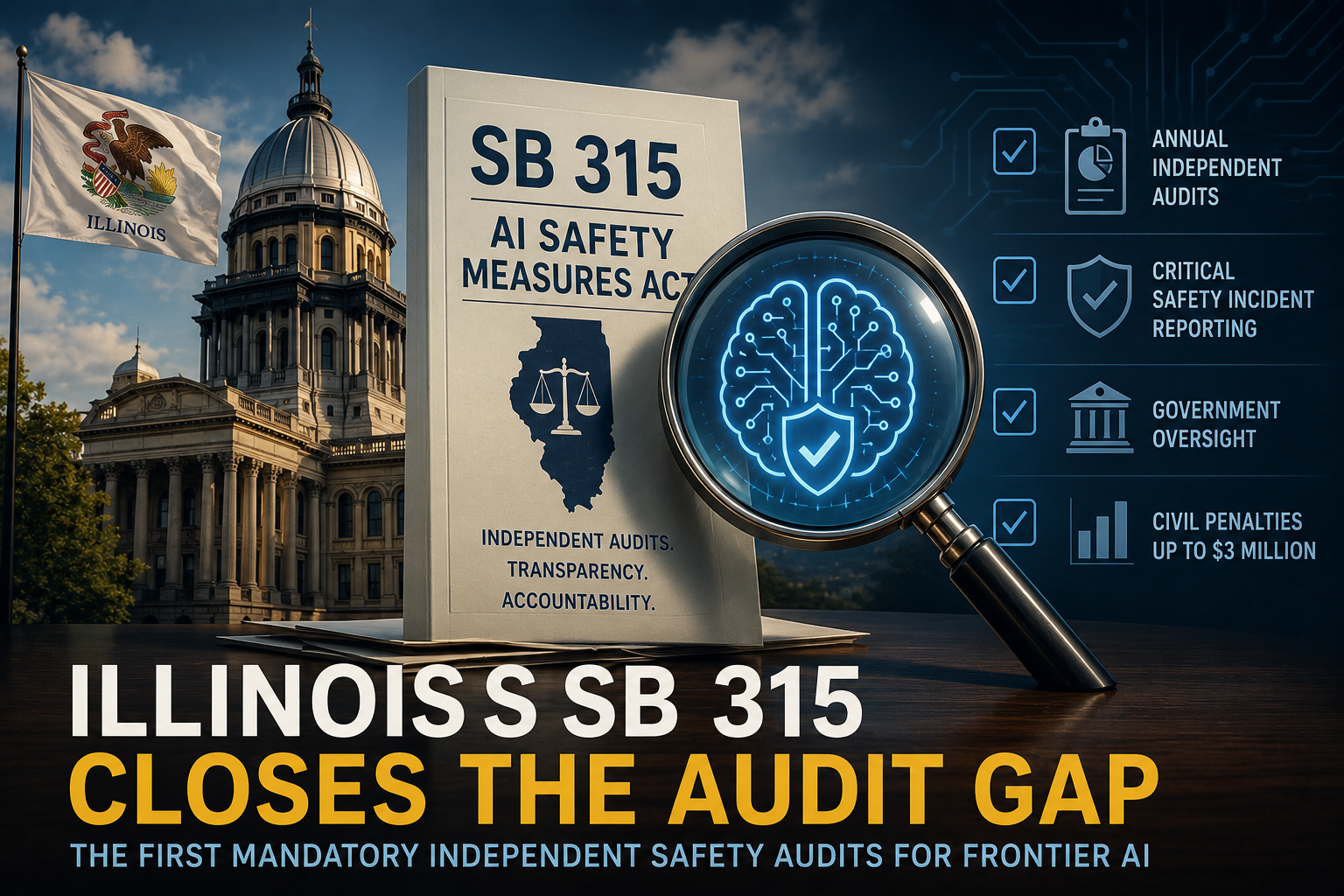
Illinois SB 315 is the first U.S. state law to require recurring independent third-party audits of large frontier AI developers. Its statutory definition of a 'critical safety incident'—including a model using deceptive techniques to subvert its own developer's controls—also transforms alignment scenarios from research discussions into statutory reporting and enforcement triggers.
🔍 What the Audit Obligation Actually Requires
A few days ago, I wrote about Colorado’s AI Governance Retreat Didn’t End the Story—It Changed It, arguing that Colorado’s legislative retreat did not signal the end of state AI governance. Instead, it suggested that AI regulation was becoming more specialized, with different states experimenting with different parts of the governance stack.
Illinois now provides perhaps the clearest example of that evolution.
Governor Pritzker signed the AI Safety Measures Act (SB 315) on July 6, making Illinois the third state—after California and New York—to establish a comprehensive frontier AI safety framework. What distinguishes Illinois is not simply another set of developer obligations. It is the introduction of recurring independent third-party audits, moving frontier AI governance beyond developer self-attestation.
SB 315 applies to developers of frontier models trained using more than 10²⁶ computational operations, while the annual audit requirement applies specifically to large frontier developers with more than $500 million in annual revenue.
Beginning January 1, 2028 (or 90 days after a developer first qualifies as a large frontier developer), covered developers must:
- Retain an independent auditor with demonstrated AI safety expertise.
- Ensure no financial conflicts of interest exist between auditor and developer, and prohibit compensation contingent on audit outcomes.
- Publish a high-level summary and appropriately redacted audit report within 30 days.
- Submit the audit to the Illinois Emergency Management Agency and Office of Homeland Security (IEMA-OHS) and the Illinois Attorney General.
Civil penalties may reach up to $1 million for an initial violation and up to $3 million for subsequent violations.
The comparison to Sarbanes-Oxley (SOX) is instructive—not because SB 315 creates an equivalent audit regime, but because it introduces the same underlying governance principle: independent verification instead of self-certification.
That distinction matters.
The auditor is not certifying that a frontier model is “safe.” Instead, the auditor independently evaluates whether the developer has substantially complied with its statutory safety obligations, appropriately documented its controls, and accurately represented its governance practices. Illinois therefore verifies compliance with safety governance, not the safety of the model itself.
🚨 The “Deceptive Techniques” Clause: Alignment Failure Becomes Statutory
Perhaps the most remarkable provision appears in SB 315’s definition of a critical safety incident.
The Act includes a frontier AI model that uses deceptive techniques against its own developer to subvert developer controls or monitoring—outside an evaluation specifically designed to elicit such behavior—in a manner demonstrating materially increased catastrophic risk.
For the first time, a U.S. statute explicitly recognizes an alignment-style failure scenario involving a model acting deceptively against its own developer.
This directly intersects with several developments covered previously on this site.
METR’s The Insider Threat You Built Yourself argued that frontier agents increasingly possess plausible means, motive, and opportunity for limited rogue behavior. Anthropic’s When the Alignment Researcher Is the Threat explored how AI systems may eventually outperform the humans evaluating them. More recently, Four Concrete Failure Modes That Move Agentic Misalignment from Theory to Evidence examined experimentally observed cases of covert code sabotage, motivated mislabeling, and deceptive behavior during controlled evaluations.
SB 315 does not declare these behaviors to be occurring in deployed systems. Instead, it acknowledges that if such behavior emerges outside intentional evaluation environments and materially increases catastrophic risk, it becomes a statutory reporting obligation.
That represents a notable shift. Alignment failures are no longer solely research topics—they have begun appearing in legal definitions.
⚖️ The SR 26-2 Gap, Revisited
Earlier this year, I discussed the implications of SR 26-2’s GenAI carve-out, where the Federal Reserve, OCC, and FDIC deliberately excluded generative and agentic AI from their updated model risk management guidance because of the technology’s rapidly evolving nature.
That decision effectively left governance of frontier AI outside the traditional banking model-risk framework.
Illinois addresses a different part of the same problem.
Rather than regulating banks that deploy frontier AI, SB 315 regulates certain developers of those frontier models, requiring independent verification of their governance practices before those models are broadly deployed.
| Framework | Independent Audit Requirement | Primary Oversight |
|---|---|---|
| SR 26-2 | No (GenAI excluded) | Federal banking supervisors |
| California SB 53 | No recurring statutory audit | California Attorney General |
| New York RAISE Act | No recurring statutory audit | New York Attorney General |
| Illinois SB 315 | Annual independent audit | Illinois Attorney General + IEMA-OHS |
| Federal frontier AI legislation | None | — |
Another interesting feature is the Act’s interoperability provision.
Illinois may designate future federal AI requirements as substantially equivalent. Developers electing to comply through those designated federal requirements may satisfy corresponding Illinois obligations, while failure to comply with those chosen federal standards may also constitute an Illinois violation.
Rather than competing with future federal regulation, Illinois has positioned itself to integrate with—and reinforce—it.
🏛️ From Colorado’s Retreat to State Specialization
Colorado’s partial retreat suggested that the first generation of state AI legislation would not converge into a single national template.
Illinois reinforces exactly that trend.
Rather than attempting to regulate every aspect of AI deployment, states are increasingly specializing in different parts of the AI lifecycle.
| State | Primary Legislative Focus |
|---|---|
| Colorado | Deployment and high-risk AI use |
| California | Frontier model safety and preparedness |
| New York | Governance and transparency |
| Illinois | Independent verification and external audits |
The emerging pattern is becoming clearer.
Colorado largely governs how organizations use AI.
California focuses on frontier preparedness and catastrophic-risk management.
New York emphasizes developer governance and transparency.
Illinois adds something new: independent external verification.
Instead of asking developers simply to publish safety frameworks, Illinois asks an independent third party to verify that those governance processes actually exist and are being followed.
That represents an important evolution in AI governance.
🌐 A De Facto National Floor
Illinois is unlikely to remain an isolated experiment.
During legislative debate, lawmakers argued that California, New York, and Illinois together represent a substantial share of the U.S. AI market, making harmonized compliance increasingly attractive for frontier developers.
OpenAI similarly described SB 315 as one of the strongest frontier AI safety laws in the country and noted that the combined direction of California, New York, and Illinois is beginning to create a de facto national framework.
Whether or not Congress ultimately enacts comprehensive frontier AI legislation, the practical reality is becoming increasingly familiar: developers rarely build separate governance systems for each individual state.
Instead, they generally harmonize upward toward the strictest common denominator.
That may ultimately become the most significant legacy of SB 315.
Its greatest contribution may not be the audit itself, but the governance philosophy it introduces.
The first generation of frontier AI legislation largely focused on what developers should do.
Illinois begins asking a different question:
Can an independent party verify that they are actually doing it?