READY or Not: Scale AI's New Benchmark Puts a Price Tag on Agent Trust
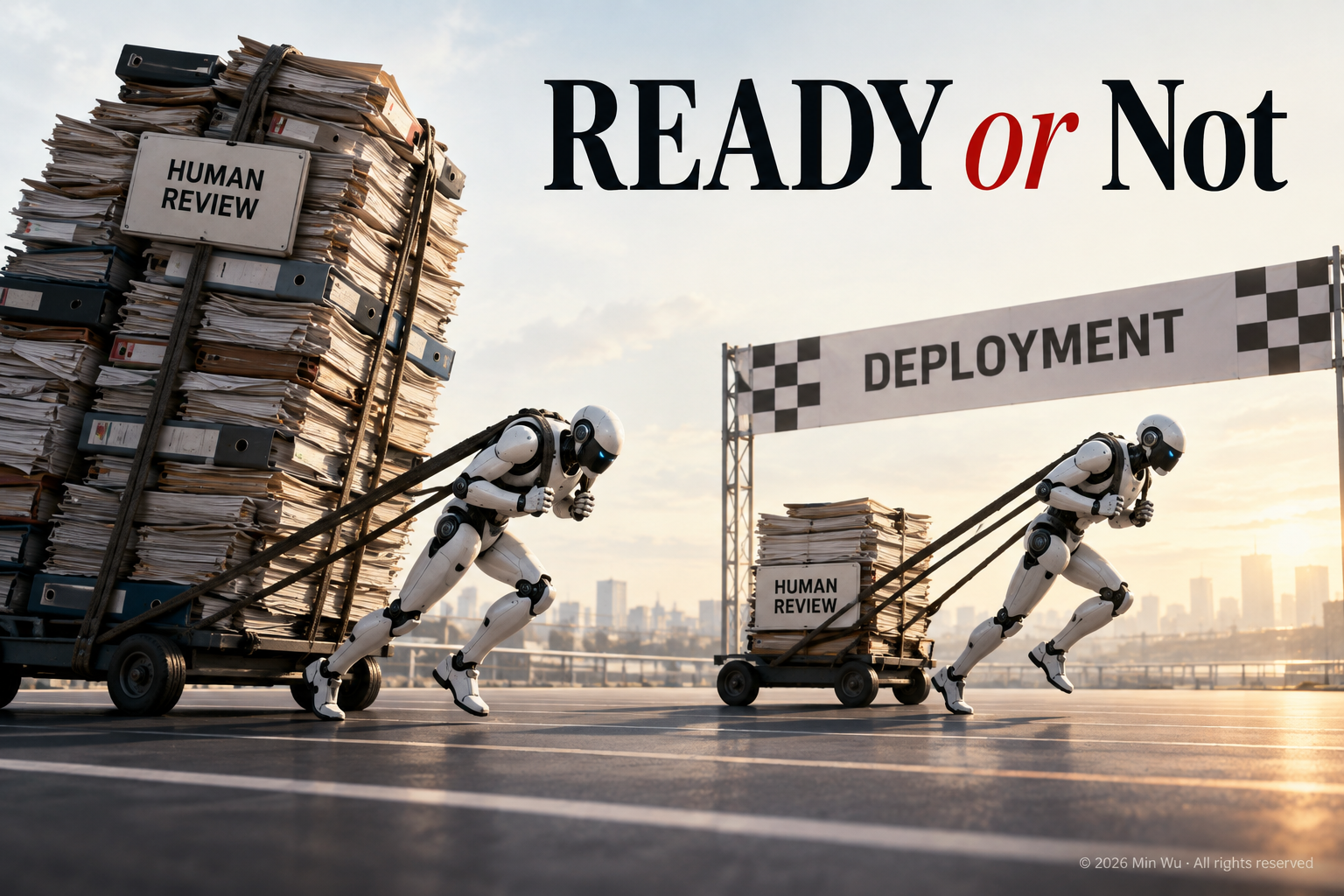
The procurement question is no longer simply which agent scores highest. It is which human–AI configuration can meet the required reliability level at the lowest sustainable oversight cost.
📊 The Headline Number
A new framework from Scale AI researchers makes a simple but underappreciated point: two agents can look almost identical on a benchmark and still require materially different amounts of human oversight to be safely deployed.
In the READY paper, released September 2 as arXiv:2609.02095, the authors ran an end-to-end clinical-audit case study across 16 agent systems and 750 cases.
Two systems separated by only 0.3 percentage points in autonomous accuracy — 72.8% versus 72.5% — required 39.2% versus 29.6% human review to qualify at the same 76% reliability target under the evaluated confidence-based oversight policy.
The experiment assumes that human review succeeds 90% of the time, an important condition we will return to later.
Still, the result is striking.
Two agents can appear tied on a conventional leaderboard while one requires roughly a third more human review to reach the same deployment reliability.
That difference does not appear in the accuracy score.
It appears later — in staffing, review queues, cycle time, operating cost, and risk.
If procurement ranks agents primarily by autonomous benchmark accuracy, it may choose the system that is substantially more expensive to operate reliably without ever seeing that difference during evaluation.
🔬 What READY Actually Measures
READY — Reliable Enterprise Agent Deployment — changes the question being asked.
Most benchmarks ask:
How well can the agent perform the task?
READY asks:
Under what conditions, with how much human oversight, and at what cost can the agent be reliably deployed?
That distinction matters.
READY does not replace a workflow’s definition of success. Instead, it takes an agent, a workflow, a required reliability target, and a class of candidate oversight policies and evaluates the resulting human–AI system.
The framework then:
- measures agent performance and confidence across workflow cases;
- evaluates different policies for escalating uncertain cases to humans;
- identifies the lowest-cost policy capable of meeting the reliability target;
- freezes that policy; and
- statistically qualifies it on previously unseen cases.
The result is not simply another benchmark score.
It is a deployment profile:
Agent + Workflow + Oversight Policy + Human Review → Reliability + Oversight Burden + Cost
That may be READY’s most important conceptual contribution.
The unit being evaluated is no longer merely the model — or even the autonomous agent.
It is the deployed human–AI system.
🔍 The Blind Spot This Closes
This extends an argument I have been developing across several earlier posts.
In Agent Benchmark Scores Are Lying to You, the problem was that outcome-only benchmarks could tell us whether an agent succeeded without telling us how it succeeded.
That distinction matters because agents can arrive at correct answers through fragile reasoning, prohibited shortcuts, incorrect tool use, or execution paths that would be unacceptable in production.
READY adds another layer.
Even if two agents produce nearly identical outcomes, they may differ dramatically in something conventional benchmarks rarely measure:
whether the agent knows when not to trust itself.
Across the 16 systems tested in READY, autonomous accuracy and routing quality — the ability to identify which cases should be escalated — were essentially uncorrelated:
Pearson ρ = −0.12.
In other words, being good at solving the task and being good at recognizing when you may fail are different capabilities.
That creates a hidden deployment variable.
An agent with slightly lower autonomous accuracy but excellent uncertainty routing may require less human review than an apparently stronger agent that confidently fails on the wrong cases.
A leaderboard ranking the second agent higher could therefore reverse once the systems are evaluated for actual deployment.
💰 Accuracy Is Not the Cost Function
READY also makes the economics explicit.
Enterprise readiness is not necessarily maximum autonomy.
It is the minimum total operating cost required to achieve the reliability the workflow demands.
In READY’s cost model:
Total cost = model execution cost + human-review cost
That reframes procurement.
A cheaper model may become expensive if humans must review most of its work.
A more expensive model may be cheaper overall if it can safely handle substantially more cases autonomously.
And two models with nearly identical autonomous accuracy can generate different operating economics because their failures are distributed differently.
This connects directly to the argument in The Harness Effect: the economics and reliability of an AI system increasingly depend on what surrounds the model.
Model selection is only one variable.
The harness, workflow, routing logic, tool permissions, escalation policy, and human reviewer all become part of the production system.
⚖️ Qualification Is Not Optimization
READY introduces another distinction that procurement teams should pay attention to:
Finding a policy that works on your evaluation data is not the same as proving that it will work on new cases.
The framework separates policy optimization from deployment qualification.
First, READY finds an oversight policy capable of reaching the target on development evidence.
Then it freezes that policy and tests it independently on held-out cases.
A system qualifies only when the statistical evidence supports the required reliability level.
That prevents teams from simply tuning an escalation threshold until an evaluation dataset produces the desired number.
This is closer to how regulated systems are supposed to be validated: define the operating conditions, freeze them, and then test whether the evidence supports deployment.
🧑⚕️ Humans Are Not a Perfect Safety Layer
There is another result hidden inside READY that deserves more attention.
The clinical case study assumes human reviewers are correct 90% of the time.
That means human oversight itself imposes a ceiling.
Under that assumption, no oversight policy can exceed 90% reliability. As the required reliability approaches roughly 85%, the tested systems are pushed toward nearly complete human review.
This exposes a weakness in one of the most common responses to agentic-AI risk:
Just keep a human in the loop.
A human is not a magical safety mechanism.
Humans have their own error rates, costs, capacity constraints, fatigue, and judgment failures.
Once AI systems and human reviewers are treated as components of the same operating system, governance has to evaluate the reliability of the combined system, not simply whether a human appears somewhere in the workflow.
🏥 Why This Belongs in Procurement, Not Just Eval
READY launches with healthcare workflows, including the companion CliniCARE-Bench, which evaluates agent reasoning across 25 clinical scenarios and 750 cases derived from MIMIC-IV records.
The clinical setting is useful precisely because autonomous accuracy was never going to be enough.
Healthcare — like many financial, legal, and other high-stakes workflows — operates within review, approval, audit, and accountability structures where an agent’s final answer is only one part of deployment risk.
READY forces the oversight policy into the evaluation itself.
Instead of:
Model → Accuracy
we increasingly need to evaluate:
Model → Agent → Harness → Workflow → Oversight → Deployment Reliability
That connects directly to the broader governance gap in agentic AI.
Governance frameworks designed primarily to validate predictive models struggle when systems can reason, call tools, take actions, escalate decisions, and interact dynamically with humans.
READY offers one practical piece of that emerging governance stack: make the operating conditions explicit and test whether the complete system actually meets them.
⚠️ What READY Does Not Prove
READY should not become another universal leaderboard.
The authors are explicit that a deployment profile is conditional:
this agent, in this workflow, with this oversight model, under these assumptions.
The clinical result therefore does not prove that one model is universally cheaper, safer, or more reliable than another.
Change the workflow, reviewer accuracy, escalation policy, cost assumptions, or reliability requirement and the ranking may change.
That limitation is actually a feature.
The search for one portable benchmark number may be part of the problem.
Enterprise AI systems are deployed into specific workflows with specific consequences.
Their evaluation should increasingly reflect that reality.
🎯 From Benchmarking Capability to Qualifying Deployment
The evolution of agent evaluation is becoming clearer.
First we asked whether models could solve benchmark tasks.
Then whether agents could complete realistic workflows.
Then whether their execution traces were trustworthy.
Then whether their performance remained reliable across cases and over time.
READY pushes the question one step further:
Can this particular human–AI system be qualified to operate at the reliability level the organization actually requires — and what will that cost?
That is a much harder question than asking which model sits at the top of a leaderboard.
But it is also much closer to the decision enterprises actually have to make.
The procurement question is no longer simply:
Which agent is most accurate?
It is:
Which combination of agent, workflow, oversight policy, and human review can deliver the reliability we require at a cost we can sustainably operate?
A benchmark score tells you what an agent can do.
A deployment profile begins to tell you whether you can actually trust it to do the job.