The Death List That Wore a Legal Face: Sulla's Proscriptions, 82 BC
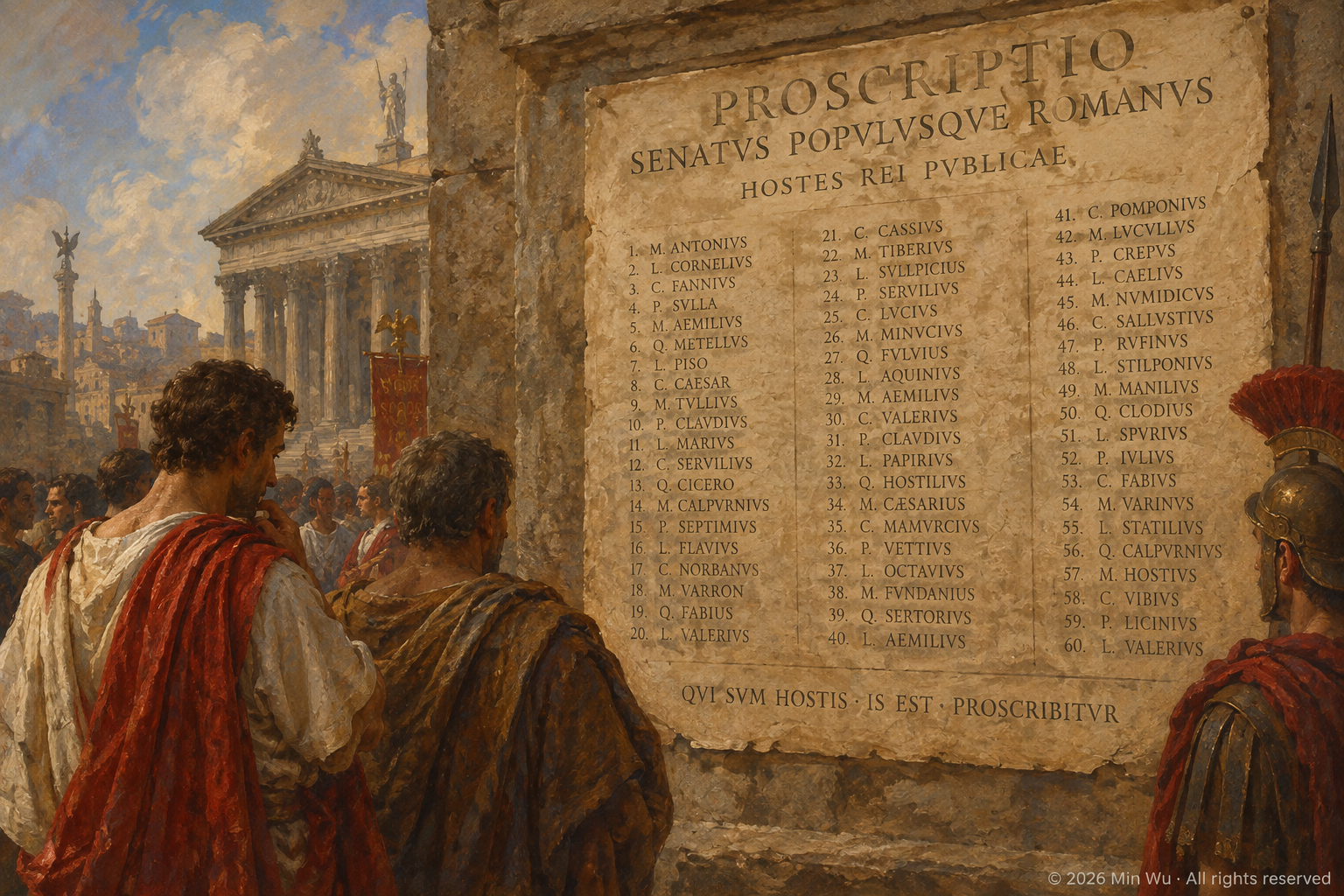
Humans preserve arrangements that work by turning decisions into reusable order. Sulla's proscriptions show the darker side of that instinct: a successful act of political violence became a procedure, then an institutional capability, and finally a precedent.
📜 The Word That Became a Death List
The Latin proscribere means “to write up” or “to publish.” Before Sulla, proscriptio could describe an ordinary public notice. After Sulla, it acquired another meaning: a death list.
That shift — from administrative routine to political killing — contains the story in miniature.
Rome already knew assassination, mob violence, confiscation, and factional revenge. Sulla did not invent political violence.
His innovation was making it governable.
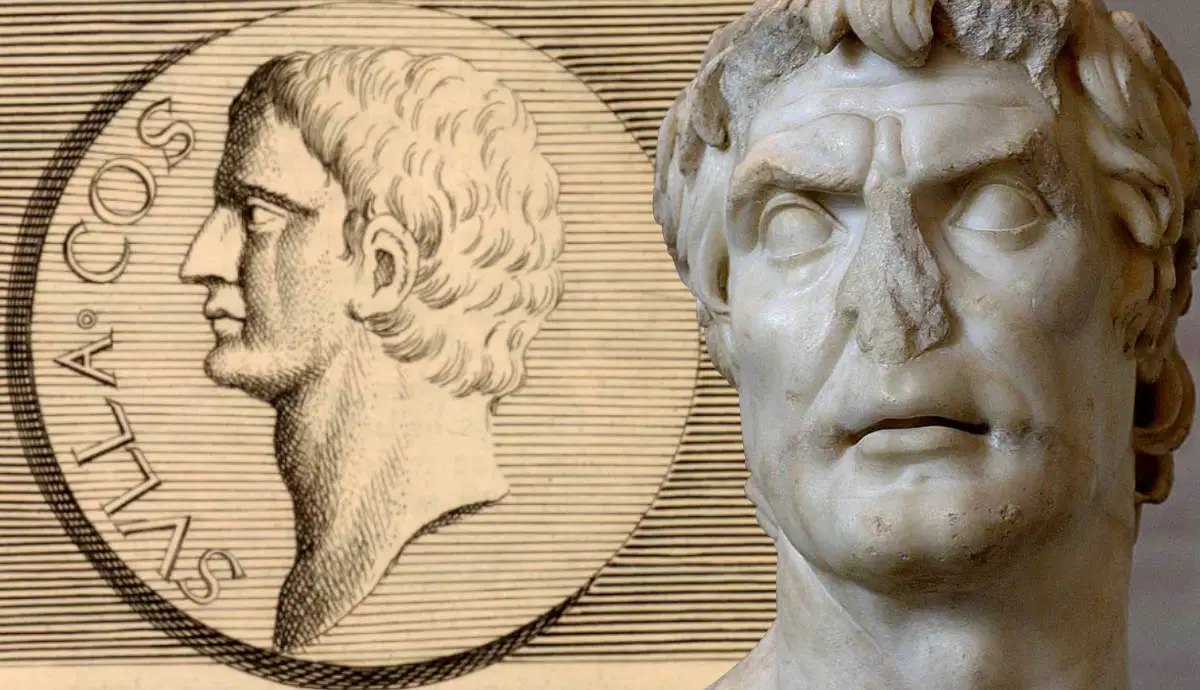
On 2 November 82 BC, after defeating his enemies at the Battle of the Colline Gate, Sulla convened the Senate in the Temple of Bellona, outside Rome’s sacred boundary, the pomerium. Nearby, thousands of captured Samnites and other prisoners were being killed.
Ancient accounts describe their cries reaching the senators inside. When those present reacted, Sulla reportedly told them to ignore the noise: only a few criminals were being punished on his orders.
Inside the temple was political deliberation. Outside was political killing.
Within days, the two would become parts of the same system.
⚙️ Making Violence Governable
The precise legislative sequence is difficult to reconstruct, but what followed is clear. Sulla began publishing lists of people designated enemies of the state.
According to Plutarch, the first list contained eighty names. Another 220 followed, then another 220 — 520 names in the first three lists. Historian François Hinard later identified 75 Sullan victims individually from the surviving evidence, although the eventual number killed was considerably larger.
To appear on the list meant more than being marked for arrest. The proscribed could be killed with impunity. Their property could be confiscated. Those who helped them could be punished. Killers and informers could receive rewards. Their descendants could lose political rights.
This changed the nature of the violence.
What had been political revenge became a sequence: identification, publication, authorization, enforcement, confiscation, redistribution.
A victorious Roman had always been able to kill an enemy. Sulla built something scalable. A published name could mobilize strangers — informers, killers, buyers of confiscated estates, and the officials who administered the transfers all now had a reason to participate.
Political violence had acquired an operating model.
💰 When Killing Created a Market
Once violence became procedural, it also generated an economy.
Confiscated estates were sold at public auctions, often far below their actual value. Marcus Licinius Crassus was among those who enriched themselves through Sullan confiscations.
The most revealing case involved Sulla’s freedman Lucius Cornelius Chrysogonus.
Sextus Roscius of Ameria had been murdered, and his name was subsequently added to the proscription lists under suspicious circumstances. His estates, which Cicero valued at six million sesterces, were sold for just 2,000 sesterces to Chrysogonus.
Roscius’s son was then accused of murdering his own father — conveniently threatening to eliminate the person best positioned to challenge the confiscation.
A young Cicero defended him in Pro Roscio Amerino, attacking the corruption surrounding Chrysogonus while carefully avoiding a direct confrontation with Sulla.
The episode shows how quickly the machinery became larger than the purge that created it. There were now killers, informers, officials, buyers, intermediaries, and beneficiaries.
Arthur Keaveney’s Sulla: The Last Republican and François Hinard’s foundational study of the proscriptions both describe the same thing: a purge that became inseparable from a massive redistribution of property and political power.
Once confiscation became legal and profitable, the system no longer depended entirely on Sulla’s political motivation. It had acquired incentives of its own.
⚖️ When the Exception Became a Capability
Sulla seized power through extraordinary violence, so it would be misleading to call the proscriptions an ordinary application of republican law. Something more interesting happened.
The extraordinary was progressively formalized.
Late in 82 BC, the lex Valeria appointed Sulla dictator legibus scribundis et rei publicae constituendae — broadly, to write laws and reconstruct the state — and gave legal force to his extraordinary position and prior actions.
Cornelian legislation subsequently stabilized the consequences of the proscriptions, including confiscations, political disabilities, and the resulting redistribution of property and power.
The significance is not that paperwork somehow made murder legitimate.
It is that an exceptional act had become an institutional capability.
| Date | Development |
|---|---|
| Nov. 82 BC | Sulla wins at the Colline Gate and begins the proscription regime |
| Nov. 82 BC | First lists published; 520 names reported across the first three |
| Late 82 BC | Lex Valeria establishes Sulla’s extraordinary dictatorship |
| 81 BC | Cornelian legislation consolidates consequences of the purge |
| 79 BC | Sulla relinquishes the dictatorship |
| 78 BC | Sulla dies |
| 43 BC | Second Triumvirate revives the mechanism |
That final entry is crucial.
🔁 Sulla Died. The Procedure Didn’t.
Four decades later, Octavian, Antony, and Lepidus did not need to invent the system again.
They reused its basic architecture: published names, legal outlawry, rewards, confiscation, and redistribution.
The most famous victim was Cicero — the same advocate who had once exposed corruption surrounding the first Sullan proscriptions.
That is what separates a procedure from an act.
An act has to be chosen again. A procedure can be inherited.
Sulla was dead. The capability survived.
📈 An Improvement in the Wrong Direction
There is an uncomfortable way to describe what happened.
The process improved.
Not morally. Not constitutionally.
Organizationally.
Political elimination became more standardized, more legible, more decentralized, more economically incentivized, and more reproducible.
These are characteristics we normally associate with institutional progress. Moving from informal to formal, arbitrary to standardized, undocumented to documented, and ad hoc to repeatable usually sounds like better governance.
But there is a more general human tendency underneath this.
When we discover an arrangement that works, we tend to preserve it rather than solve the same problem again. A decision repeated often enough becomes a habit. Organizations turn repeated decisions into procedures. Political systems turn them into laws and institutions.
Part of the reason is simple economy. Reconsidering everything continuously is expensive. A company, for example, does not normally renegotiate every employee’s compensation each month according to that month’s exact contribution. It establishes a salary, reviews it periodically, and thereby compresses thousands of possible decisions into a relatively stable arrangement.
There is another force as well: people who benefit from an existing order have an incentive to preserve it. For someone with enough power, “this worked for me” can gradually become “this is how we do it” — and eventually “this is the rule.”
The same mechanism can therefore create useful institutions or destructive ones. The mechanism itself is not moral. It is a way of preserving successful responses.
From Decision to Durable Order
      Something works
             │
             ▼
         REPEAT IT
             │
        ┌────┴────┐
        │         │
        ▼         ▼
 Saves effort   Protects interests
        │         │
        └────┬────┘
             ▼
       STANDARDIZE IT
             │
             ▼
   Habit · Procedure · Law
             │
             ▼
       REUSABLE ORDER
             │
       ┌─────┴─────┐
       ▼           ▼
  Conditions     Conditions
 still fit       have changed
       │           │
       ▼           ▼
 Useful order   Institutional
                  inertia
🤖 Why This Matters Now
That right-hand branch — conditions change, the procedure does not — is not an ancient problem.
The modern parallel is structural, not partisan.
Organizations today are extraordinarily good at proceduralization. When decisions are inconsistent, we standardize them. When processes are slow, we automate them. When accountability is unclear, we create controls, workflows, metrics, escalation paths, and audit trails.
Usually that represents genuine progress.
But Sulla’s experience suggests that process maturity and institutional health are not the same variable.
A compliance process can grow more efficient while shifting from identifying genuine misconduct toward producing reasons for predetermined outcomes. A legal review can grow sophisticated at constructing defensible routes to a decision rather than independently testing it.
Automation makes this distinction even more important.
A flawed judgment made by one person is limited by that person’s reach. A flawed objective embedded into a workflow becomes consistent and persistent. Embedded into software, it becomes scalable. Embedded into AI-driven systems, that scale can expand dramatically further.
🎯 The Question Before Efficiency
If the mechanism itself is neutral, then the mechanism cannot be the test.
“Was the procedure followed?” is necessary but insufficient. The prior question is what objective the procedure serves — and whether that objective deserves to become standardized, efficient, and reproducible.
Perhaps the most useful question Sulla leaves us is therefore:
Would we still want this procedure to exist if it worked perfectly?
Sulla’s enduring innovation was not simply the death list. It was demonstrating that political violence could move from an act to a process, from a process to a capability, and from a capability to a precedent.
Rome did not merely kill its political enemies in 82 BC.
It learned how to run a system for doing it.