The Fleet That Outlived Its Emperor by Exactly One Generation
A leader can repeatedly defeat a bureaucracy in individual decisions and still lose institutionally. The bureaucracy does not have to win today if it controls the budgets, records, staffing, and implementation after the leader is gone.
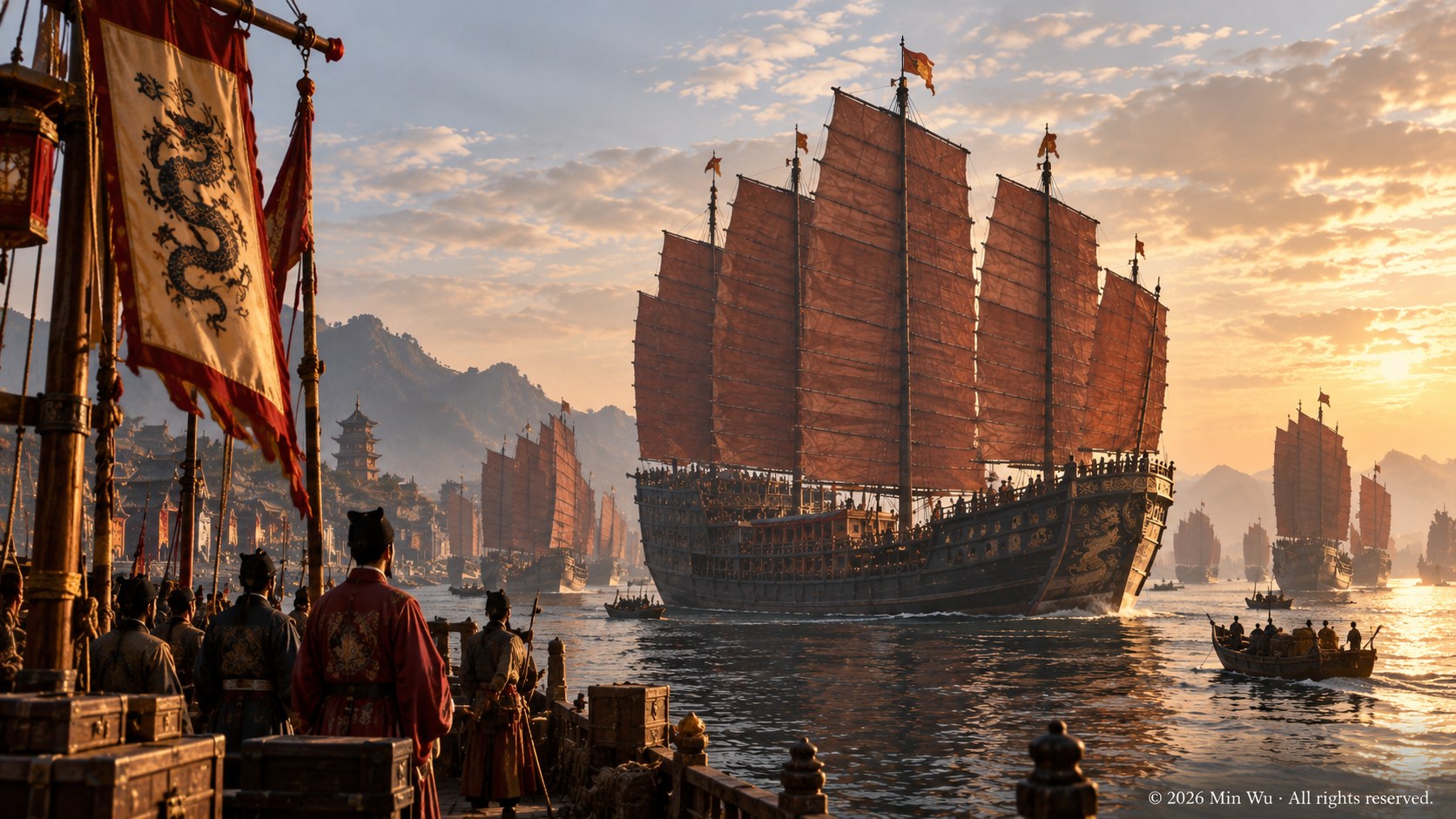
In 1405, the Yongle Emperor sent an extraordinary fleet out of Nanjing bearing imperial letters to the countries of the “Western Ocean.” The expedition carried roughly 27,800 men and 62 treasure ships; one influential reconstruction puts the entire fleet at roughly 255 vessels.
Later Ming accounts attributed lengths of more than 400 feet to the largest treasure ships, although modern historians dispute whether wooden vessels that enormous were actually built.
Either way, the scale was extraordinary. Zheng He’s fleets were among the largest and most powerful naval forces of their age.
Columbus would not leave Spain for another 87 years.
The man Yongle put in command was Zheng He — a Muslim boy from Yunnan, captured by Ming forces as a child, castrated, and eventually placed in the household of the prince who would become emperor. Over the next twenty-eight years, Zheng He participated in seven expeditions reaching Southeast Asia, India, the Persian Gulf, Arabia, and the coast of East Africa, returning with foreign envoys and tribute missions that projected Ming power across the Indian Ocean.
None of this happened simply because “China decided to explore.”
It happened inside a political system in which an unusually powerful emperor had found ways to overcome institutions that often resisted what he wanted to do.
👑 A usurper’s workaround
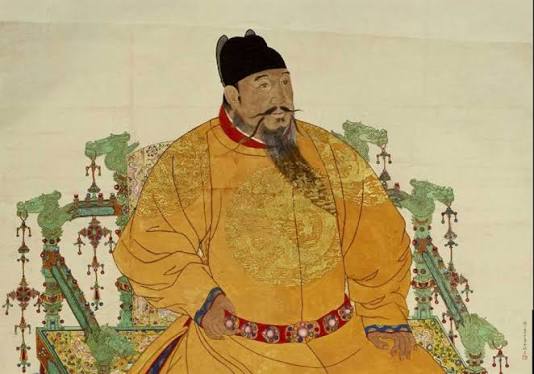
Yongle took the throne by force, overthrowing his nephew, the Jianwen Emperor, in 1402.
The Confucian scholar-official establishment did not universally accept his legitimacy. The reprisals were severe. Fang Xiaoru, the scholar who famously refused to legitimize Yongle’s accession, was executed, and the new regime carried out a broader purge of Jianwen loyalists.
Having seized the throne against resistance from parts of the educated elite, Yongle increasingly relied on another source of administrative power: eunuchs personally dependent on the emperor.
That distinction mattered.
Scholar-officials derived authority from examinations, bureaucratic offices, and a political tradition that gave them an institutional basis for remonstrating with the throne. Eunuchs depended much more directly on imperial patronage.
Yongle used them accordingly.
He expanded eunuch participation in diplomacy, intelligence, military affairs, manufacturing, procurement, and palace finance. In 1420 he established the Eastern Depot, an intelligence and secret-police organization staffed by eunuchs.
And most spectacularly, he placed eunuchs such as Zheng He at the center of his maritime expeditions.
The voyages were not completely separate from normal government — officials from regular ministries participated in them. But Yongle gave eunuch commanders special authority to withdraw money and goods directly from imperial treasuries, substantially reducing the ordinary bureaucracy’s ability to stop expenditures it opposed.
The treasure fleet therefore wasn’t just a diplomatic, military, and commercial instrument.
It was also an institutional workaround.
Yongle had created a channel through which imperial priorities could move around some of the constraints imposed by the permanent bureaucracy.
⏳ The bureaucracy doesn’t have to win today
But the scholar-officials did not simply sit quietly and wait for Yongle to die.
They fought him while he was alive.
In 1421, after fire destroyed major halls of the newly constructed Forbidden City, Yongle invited officials to identify failures in government. Critics attacked the immense fiscal burden of his military campaigns, construction projects, and maritime expeditions.
The pressure became strong enough that Yongle ordered a cessation of the voyages and the construction of new seagoing vessels.
Then he reversed course.
That is the more interesting institutional story.
Yongle could defeat bureaucratic resistance. He could not eliminate it.
His extraordinary personal authority allowed him repeatedly to override the equilibrium of the system.
But personal authority has an expiration date.
Yongle died in 1424 while campaigning against the Mongols. His son, the Hongxi Emperor, quickly terminated the maritime expeditions, redirecting attention toward fiscal restraint and the northern frontier.
Hongxi himself died less than a year later.
His son, the Xuande Emperor, eventually revived the program. Zheng He departed on the seventh and final expedition in 1431 and probably died during the return journey in 1433.
Then Xuande died in 1435.
His successor was eight years old.
And this time, the institutional machinery behind the voyages began to disappear.
⚙️ How an institution kills a project
The end did not require someone to burn the fleet in a single dramatic act.
It happened administratively.
This is what bureaucratic power often looks like.
Not:
NO MORE TREASURE FLEETS
but:
Office abolished.
Budget unavailable.
Personnel reassigned.
Procurement discontinued.
Records inaccessible.
Nothing individually looks like the end of an era.
Together, they make restarting the project progressively harder.
And decades later, even the institutional memory became contested.
When the Chenghua Emperor reportedly considered another maritime expedition, records of Zheng He’s voyages could not be produced. Later Ming accounts associated their disappearance with the official Liu Daxia, an opponent of renewed expeditions who was said to have removed or destroyed the documents so future rulers could not use them as a blueprint.
Whether Liu literally destroyed the archive is harder to establish than later retellings sometimes imply.
The political logic behind the story, however, fits a much better-documented pattern: officials opposing renewed voyages were not merely trying to stop one expedition.
They were making the capability harder to reconstruct.
⚖️ What the parallel is — and isn’t
The tempting interpretation is:
China turned inward and missed its moment.
That turns a complicated institutional struggle into a civilizational personality trait.
What happened was narrower and more mechanical.
Recent scholarship has explicitly interpreted the rise and termination of the voyages through the fiscal competition between Ming emperors and their bureaucracy.
The voyages depended heavily on an unusually powerful executive sponsor, alternative channels of financing and administration, and officials personally tied to the throne.
The institutions opposing them had something Yongle did not.
Time.
Every large organization contains some version of this asymmetry.
Executives arrive with mandates, priorities, and finite political capital. Career institutions persist across leadership changes. They control implementation, records, procurement, staffing, budgets, and eventually institutional memory itself.
A sufficiently powerful leader can override those systems.
But overriding an institution is not the same thing as changing its equilibrium.
Yongle demonstrated that distinction almost perfectly.
During his reign, the rough structure looked like:
Emperor → eunuch apparatus → resources → fleet
After succession, it increasingly became:
bureaucracy → budgets + staffing + procurement + records → institutional equilibrium
The emperor could win the argument.
The institution could survive the emperor.
🧭 The one-generation test
This suggests a useful test for any leader trying to build something that conflicts with an organization’s existing incentives:
What happens to the project one generation after you leave?
If it survives only because you personally authorize the budget, appoint loyal operators, override objections, or maintain a parallel chain of command, you may not have changed the institution at all.
You may simply have suspended it.
The treasure voyages survived Yongle.
Xuande even managed to restart them.
But the underlying institutional coalition remained.
Once the exceptional rulers were gone, the organization did not need a dramatic counterrevolution. It needed only to regain control of ordinary administrative machinery.
The equilibrium reasserted itself through budgets, staffing decisions, procurement rules, offices, ships, and records.
That may be the deeper lesson of Zheng He’s fleet.
A leader can win every important decision of his reign and still lose the institution after he leaves.
Because executives measure power in decisions.
Institutions measure it in time.