The Reddit Lawsuit Reveals a Larger AI Governance Question Than Copyright
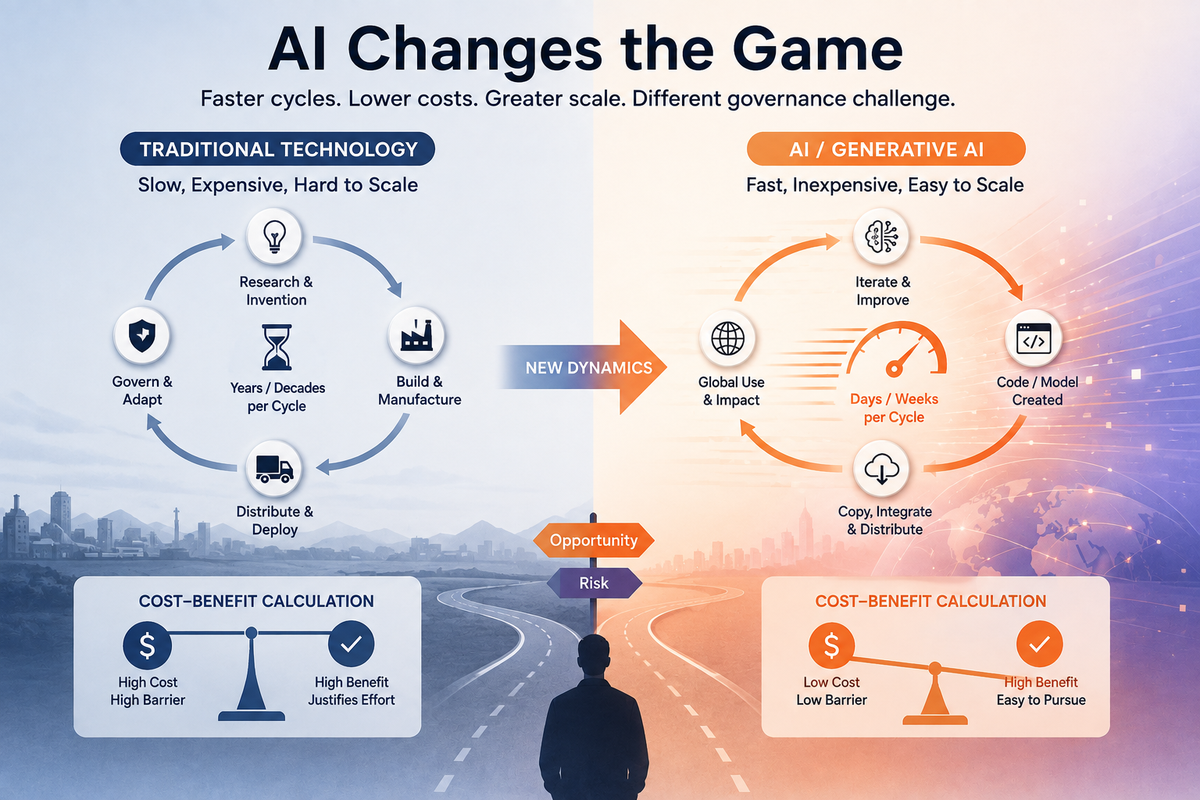
The legal doctrines governing unauthorized access and copyright are not new. What may be changing is the technological environment in which they operate: AI is making sophisticated capabilities cheaper, easier to replicate, globally accessible, and still rapidly evolving. The governance challenge may therefore be less about inventing new rules than about whether existing institutions can adapt quickly enough.
Another AI Copyright Lawsuit?
On July 31, 2026, Judge Paul Engelmayer of the U.S. District Court for the Southern District of New York largely denied motions to dismiss Reddit’s lawsuit against Perplexity and SerpApi in Reddit Inc. v. SerpApi LLC et al. (Opinion). The decision, which was also reported by Reuters, allows most of Reddit’s principal claims to proceed to discovery while dismissing several state-law claims.
Reddit alleges that SerpApi bypassed Google’s anti-bot protections to collect Reddit content at scale, and that Perplexity played more than a passive role in obtaining or using that data. The court did not decide whether the defendants ultimately violated the law. It concluded only that Reddit had plausibly alleged sufficient facts for the litigation to continue.
Most discussions have therefore framed the case as another battle over AI and copyrighted content.
That is certainly one way to view it.
But I think the lawsuit reveals a much broader governance question.
The Rules Have Not Fundamentally Changed
Suppose I write a book.
You may buy it.
You may read it.
Depending on the circumstances, you may quote portions of it.
But you generally cannot duplicate the entire book, repackage it, and build a commercial business around selling copies without permission.
Likewise, cybersecurity and digital-access laws have long prohibited bypassing technical protections to obtain digital content through unauthorized means.
None of these legal principles are new.
The Digital Millennium Copyright Act (DMCA) was enacted in 1998—long before anyone imagined today’s frontier AI systems. As Judge Engelmayer notes in the opinion, Congress originally enacted the statute to combat digital piracy, while AI has now “added a new dimension” to questions surrounding copyrighted works and technological protection measures (Opinion).
So perhaps the most interesting question is not whether the rules have changed.
It is whether the technological environment in which those rules operate has fundamentally changed.
Every Technology Is a Double-Edged Sword
History suggests that AI is not unique in creating both opportunity and risk.
Electricity transformed industry while introducing entirely new safety hazards.
Automobiles revolutionized transportation while creating traffic fatalities.
The Internet democratized information while enabling cybercrime.
Nearly every transformative technology lowers the cost of beneficial activities while simultaneously lowering the cost of misuse.
Eventually, society adapts.
Security improves.
Standards emerge.
Legal doctrines evolve.
A new equilibrium forms.
In that sense, AI is probably following a familiar historical pattern rather than creating an entirely unprecedented one.
The more interesting question is whether AI changes how quickly that cycle unfolds.
Traditional Technologies Eventually Stabilize
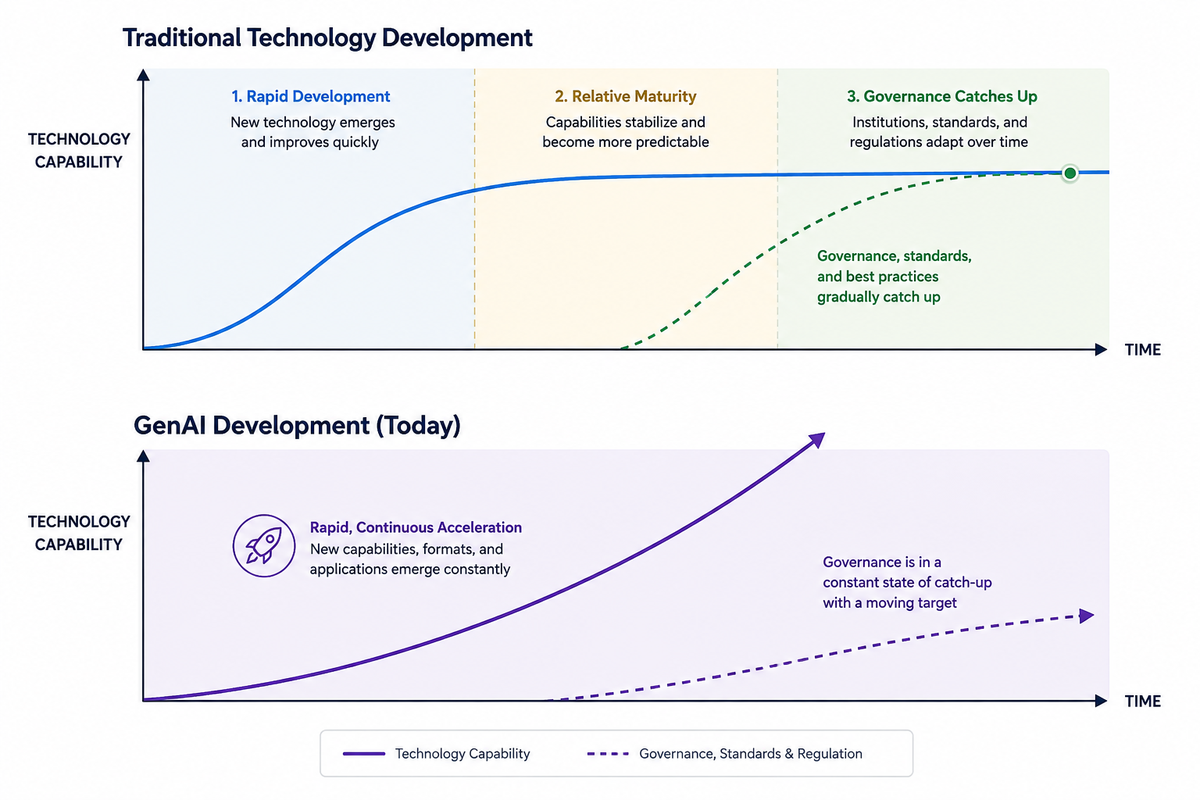
Most major technologies have followed a broadly similar trajectory. Traditional technologies typically enter a period of relative maturity, allowing governance, engineering standards, education, and security practices to gradually catch up.
Electricity required infrastructure.
Automobiles required factories, roads, fuel distribution, and physical ownership.
Personal computers were initially expensive and accessible to relatively few people.
These practical barriers slowed adoption and gave institutions—however imperfectly—time to study, regulate, and understand the technology.
AI May Be Challenging Three Traditional Assumptions
The concern is not that AI breaks existing legal doctrines.
It is that AI may be changing several assumptions upon which those doctrines implicitly rely.
| Traditional assumption | AI environment |
|---|---|
| Sophisticated capability is expensive and requires specialists | Advanced capability is becoming cheaper and easier to access |
| Scaling requires manufacturing, infrastructure, and physical distribution | Software can be copied and distributed globally at near-zero marginal cost |
| Technologies eventually stabilize and become easier to govern | AI’s mature form and capability ceiling remain uncertain |
Table 1. AI may be challenging several assumptions around which modern governance has gradually evolved.
None of these characteristics is individually new.
Technology has always reduced costs.
Software has always been easier to replicate than hardware.
Innovation has always outpaced regulation.
The interesting possibility is that AI combines all three simultaneously.
AI Inherits the Economics of Software
This may be the most important distinction.
A vehicle can certainly be dangerous.
But scaling that capability requires physical production.
Someone must obtain materials.
Factories must manufacture vehicles.
They must be transported, sold, fueled, and maintained.
Physical technologies are constrained by manufacturing capacity and supply chains.
AI is different because it is fundamentally software.
Once a capability has been developed, it can often be:
- copied,
- downloaded,
- open sourced,
- fine-tuned,
- integrated into other applications,
- and distributed worldwide almost instantly.
The marginal cost of replication approaches zero.
That does not mean frontier AI models are inexpensive to develop.
Training cutting-edge models still requires enormous computing resources.
But once a capability becomes available through APIs, open-weight releases, or software packages, its diffusion can occur dramatically faster than most physical technologies.
We Still Don’t Know What “Mature AI” Looks Like
Perhaps the biggest uncertainty is not AI’s current capability.
It is whether we have any idea where the technology eventually stabilizes.
Most previous technologies eventually became relatively predictable.
Cars became better cars.
Computers became faster computers.
The underlying paradigm remained recognizable.
AI feels different.
Every year introduces capabilities that many experts did not confidently predict:
- advanced reasoning,
- coding,
- multimodal interaction,
- autonomous agents,
- scientific discovery,
- robotics integration,
- rapidly improving open-weight models.
Perhaps AI will eventually enter a similar period of maturity.
Perhaps it will not.
At this point, we simply do not know.
That uncertainty itself becomes a governance challenge.
The Cost-Benefit Calculation Changes
Schools have always prohibited cheating.
That rule remains perfectly valid today.
Now imagine every student suddenly receives an AI assistant capable of answering exam questions almost instantly and at negligible cost.
The rule has not changed.
The incentives have.
When the expected benefit remains high while the cost, effort, and technical barrier decline dramatically, more people are likely to attempt misconduct unless detection and deterrence improve as well.
Cybersecurity may be experiencing a similar shift.
Historically, conducting sophisticated scraping or bypassing technical protections often required:
- specialized engineers,
- significant infrastructure,
- deep technical expertise,
- continuous maintenance,
- substantial financial investment.
AI increasingly assists with writing software, interpreting documentation, automating experimentation, and lowering the expertise required for complex technical tasks.
The legal prohibition remains.
The practical capability threshold may not.
The Reddit Lawsuit as a Symptom
The Reddit lawsuit does not prove that AI autonomously defeated Google’s protections.
Nor has the court concluded that Perplexity or SerpApi violated the law.
The judge ruled only that Reddit’s allegations deserve to proceed to discovery.
Nevertheless, the case illustrates a broader environment:
- proprietary data,
- automated acquisition,
- technical access controls,
- commercial incentives,
- and decades-old legal doctrines being applied to rapidly evolving AI systems.
It is simultaneously a copyright dispute, a cybersecurity dispute, and a governance case.
More importantly, it raises a question that extends far beyond Reddit.
A Moving Target for Governance?
Perhaps AI will ultimately follow the same historical trajectory as electricity, automobiles, personal computers, and the Internet.
Countermeasures will improve.
Security practices will mature.
Courts will clarify legal boundaries.
Regulators will adapt.
A new equilibrium will emerge.
History suggests that this is entirely possible.
But there is another possibility.
If AI continues improving rapidly, remains inexpensive to access, and can be replicated almost instantly because it is software, governance may spend much of its time responding to a technology that has already evolved again.
The Reddit lawsuit does not answer that question.
It simply reminds us that the most important governance challenges are often not about whether the rules have changed.
They are about whether the assumptions behind those rules still hold.
The legal principles governing copyright, cybersecurity, and unauthorized access may remain entirely valid.
The question is whether they were designed for a world in which sophisticated capability was expensive, specialized, difficult to replicate, and eventually stable.
AI may be challenging all four assumptions at once.