The Secret That Had to Be Wasted on Purpose
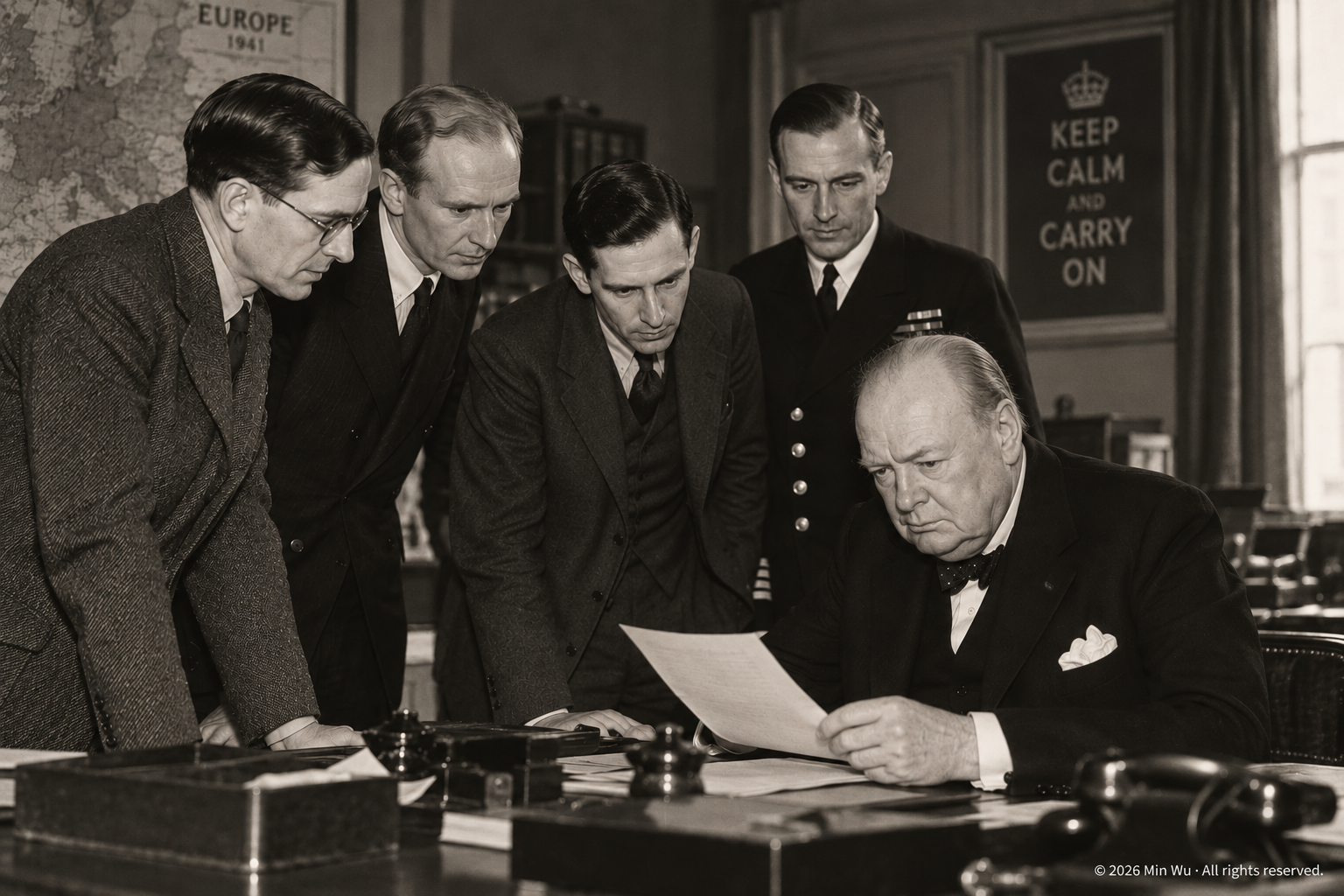
An information advantage that is exploited perfectly may destroy itself. The hardest intelligence problem is therefore not acquiring secret information, but deciding how much of it you can afford to use without revealing that you have it.
📜 The letter that broke the chain of command
On 21 October 1941, four cryptanalysts at Bletchley Park did something that could have ended their careers.
They went around their own chain of command and wrote directly to the Prime Minister.
The letter was polite, almost apologetic. Alan Turing, Gordon Welchman, Hugh Alexander, and Stuart Milner-Barry explained that they were breaking into German military traffic, but that the work was “being held up, and in some cases is not being done at all, principally because we cannot get sufficient staff to deal with it.”
They needed typists. Clerks. WRNS personnel.
Unglamorous people, in unglamorous numbers, and Whitehall’s ordinary bureaucracy wasn’t delivering them.
Milner-Barry carried the letter to London himself. He later described in a 1986 recollection how he delivered the secret appeal through Downing Street.
Churchill read it and acted immediately.
His handwritten instruction was characteristically short:
“Make sure they have all they want on extreme priority and report to me that this has been done.”
By 18 November, Churchill’s military adviser Hastings Ismay reported that Bletchley’s labour requirements were being “very rapidly met,” although the process was not yet entirely complete.
The episode later became known as “Action This Day.” The National Archives still holds the original letter — four scientists bypassing layers of hierarchy because one of Britain’s most important wartime capabilities was being constrained by clerical shortages.
But what makes the story worth retelling isn’t the bureaucratic fix.
It’s what the fix protected.
🔐 Knowing something you cannot fully use
By 1941, Bletchley Park was reading important German Enigma traffic, including naval communications that could help Britain understand U-boat operations in the Atlantic.
The resulting high-grade signals intelligence became known under the classification Ultra.
Its extraordinary value created an equally extraordinary problem:
The more successfully Britain exploited the intelligence, the greater the risk that Germany would realize its communications were compromised.
That meant Ultra could not be distributed like ordinary intelligence.
Special Liaison Units accompanied commands authorized to receive it. Access was tightly controlled. Intelligence derived from Ultra had to be handled through special channels, and commanders could not simply issue an order that revealed knowledge they could only plausibly have obtained by reading German communications.
The problem was not merely secrecy.
It was behavioral secrecy.
If Ultra revealed the location of an enemy convoy, Britain ideally needed some independent-looking reason to find that convoy — reconnaissance aircraft, patrols, another intelligence source, something that could plausibly explain what happened next.
The intelligence therefore had two values.
Its immediate value was what Britain could gain by acting on today’s decrypt.
Its future value was everything Britain might learn tomorrow if Germany continued using the compromised system.
Those two values could conflict.
🎯 Why perfect exploitation becomes self-defeating
Imagine an intelligence service that successfully decrypts an enemy’s communications.
Every submarine revealed by the system is avoided.
Every convoy identified by it is attacked.
Every ambush is anticipated.
Every operational plan is countered.
From the intelligence service’s perspective, this looks like perfect performance.
From the enemy’s perspective, it begins to look impossible.
Eventually the pattern itself becomes information.
The enemy does not need to know how its communications were compromised. It only needs to become sufficiently suspicious that they were compromised.
That is why the rational exploitation rate of secret intelligence can be less than 100 percent.
Sometimes the optimal use of information is to disguise its use.
Sometimes it is to delay its use.
And sometimes it is not to exploit a particular piece of information at all.
The objective is not to maximize the value of today’s intercept.
It is to maximize the lifetime value of the source.
🏚️ The Coventry story — and why the myth matters
The most famous story about this dilemma is probably also the most misleading.
In The Ultra Secret, F. W. Winterbotham helped popularize the claim that Churchill knew Coventry would be bombed on 14 November 1940 but withheld a warning because evacuating the city would reveal that Britain had broken Enigma.
It is a compelling story.
The surviving evidence does not support it.
Later documentary research and accounts from other participants showed that intelligence indicated a major German raid but did not identify Coventry as the definite target early enough to create the clean moral choice Winterbotham described. Churchill’s own movements are consistent with an expectation that London might be attacked.
GCHQ now describes the idea that Churchill deliberately sacrificed Coventry as a widely spread myth.
But the persistence of the story is revealing.
It took a genuine operational dilemma — how much intelligence can you exploit without exposing its source? — and converted it into its most dramatic imaginable form.
Churchill probably did not sacrifice Coventry to protect Ultra.
The machinery built to protect Ultra, however, really did force commanders to think constantly about whether acting on good intelligence could destroy the source that produced it.
✈️ Making knowledge look like luck
The danger was not theoretical.
During the Mediterranean campaign, Ultra helped the Allies understand Axis shipping movements with extraordinary precision.
But precision itself could become suspicious.
At one point German analysts observing Allied attacks on Mediterranean convoys concluded that the accuracy was difficult to explain by ordinary reconnaissance. In one intercepted German message, Fliegerkorps Tunis suggested that Allied activity pointed toward the conclusion that convoy routes had been “betrayed to the enemy.”
The irony was almost perfect.
The Germans transmitted their suspicion.
The British intercepted that too.
This was why cover mattered.
If Ultra indicated where an Axis convoy would be, reconnaissance aircraft could be sent into the area so that German observers had another explanation for the subsequent attack.
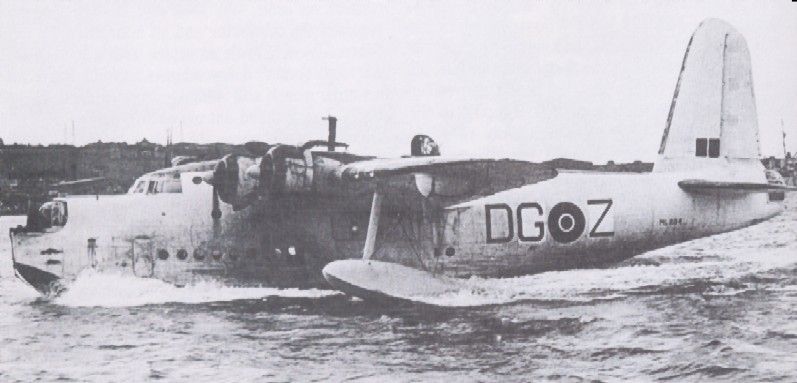 Short Sunderland GR.Mk.III. Source: ww2aircraft.net
The aircraft was not necessarily discovering the convoy.
Sometimes its job was to make it look as though it had.
Britain wasn’t merely protecting information. It was manufacturing an alternative explanation for why Britain knew what it knew.
That is a much more sophisticated organizational capability.
🧠 The organization had to pretend to know less
There is a strange institutional lesson here.
Organizations normally reward visible use of information.
If an intelligence unit produces an insight, commanders are expected to act on it. If analysts discover something valuable, the organization wants measurable results from that discovery.
Ultra required almost the opposite discipline:
know → conceal that you know → create an innocent explanation → act selectively → preserve the source → learn again tomorrow.
The most sophisticated response to superior information was therefore sometimes to behave less efficiently than the information theoretically allowed.
A perfectly optimized organization would exploit every advantage.
A strategically optimized organization sometimes had to waste one.
That distinction extends far beyond wartime cryptography.
Cyber defenders who reveal exactly what intrusion they detected can teach an attacker how their monitoring works.
Fraud systems that block every suspicious transaction immediately can reveal their detection thresholds.
Counterintelligence services that arrest every identified operative may destroy their ability to map the larger network.
Even organizations negotiating with competitors can lose informational advantages simply by behaving as though they know too much.
In each case, information has value partly because the other side does not know you possess it.
Using it changes that condition.
🤐 Thirty years of silence
The discipline continued after the war.
Bletchley veterans remained bound by the Official Secrets Act, and the Ultra story stayed largely outside public knowledge for decades.
That began changing in the 1970s.
The British government had already commissioned F. H. Hinsley — a Cambridge historian who had himself worked at Bletchley Park — and others to produce an official history of wartime intelligence in 1971.
Then, in 1974, F. W. Winterbotham published The Ultra Secret, bringing the basic story of Ultra to a mass audience.
Winterbotham’s account contained important errors and helped create some myths that later historians would dismantle. But the broader revelation was extraordinary.
For decades, thousands of people had participated in one of the most consequential intelligence operations of the war.
And most had said almost nothing.
The first volume of Hinsley’s official British Intelligence in the Second World War finally appeared in 1979.
The secret had survived the war by more than a generation.
⚖️ The real scarce resource
The obvious lesson of Bletchley Park is that information is power.
But Ultra suggests something more difficult.
Information that nobody knows you possess can be more valuable than information you visibly exploit.
That means acquiring an informational advantage is only half the problem.
The other half is controlling your own behavior once you have it.
Bletchley Park needed mathematicians capable of breaking Enigma.
It needed engineers capable of building bombes.
It needed typists and clerks capable of processing industrial quantities of intercepted traffic.
But Britain also needed commanders capable of receiving extraordinary intelligence and resisting the natural impulse to use every piece of it immediately.
That may have been one of the least visible achievements of the entire system.
The secret was valuable because Germany did not know Britain had it.
So Britain occasionally had to behave as though it didn’t.
The best use of superior information is not always to act smarter.
Sometimes it is to know exactly how much stupidity you can afford to display today — so that you can still know the secret tomorrow.