The UN Put Every Nation at the AI Governance Table — Here's What It Actually Built
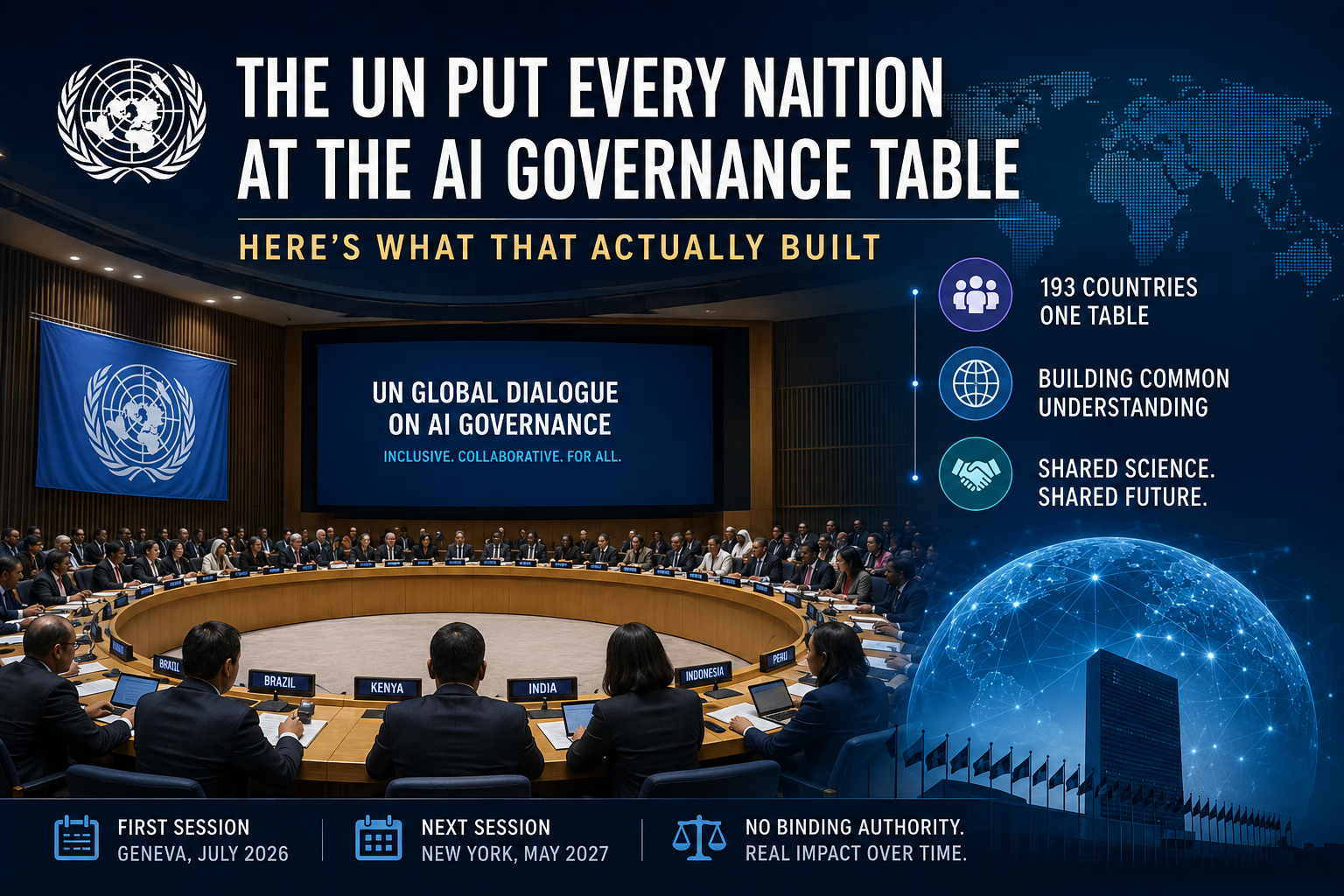
The Dialogue is a permanent diplomatic forum—not a regulator. Its value lies in building shared scientific understanding and governance norms that national laws can later act upon, rather than replacing binding regulatory regimes like the EU AI Act.
🌐 Two New UN Institutions, Two Different Jobs
In my previous article, The First Global Scientific Baseline for AI Safety, I examined the work of the UN’s Independent International Scientific Panel on AI. Its role is to synthesize the best available scientific evidence on frontier AI risks—not to regulate AI.
The inaugural UN Global Dialogue on AI Governance, held this week in Geneva, represents the second half of that architecture.
The Scientific Panel establishes the evidence.
The Global Dialogue brings every UN Member State together to discuss what governments should do with it.
Understanding that distinction helps explain both the Dialogue’s strengths and its limitations.
🏛️ What Was Actually Built?
The Dialogue is the first UN General Assembly-convened global platform where all 193 UN Member States, alongside the private sector, civil society, academia, and the technical community, participate in discussions on AI governance.
That universality is the point.
Many countries—particularly those from the Global South and Least Developed Countries—have had limited influence over AI governance initiatives led by the G7, G20, OECD, Council of Europe, and the EU. The Dialogue gives them something equally important: a formal voice in shaping future international AI governance.
Established by UN General Assembly Resolution A/RES/79/325, the Dialogue is designed as a recurring forum rather than a negotiating body. It exchanges best practices, builds common understanding, and encourages cooperation, but it does not adopt binding rules.
Its first session was co-chaired by Egriselda López (El Salvador) and Rein Tammsaar (Estonia), with the second Dialogue scheduled for New York in May 2027.
📌 Scientific Consensus ≠ Global Regulation
One misconception is that the Dialogue represents the beginning of a global AI regulator.
It does not.
| Layer | Example | Binding? |
|---|---|---|
| Scientific consensus | UN Scientific Panel | ❌ |
| Diplomatic dialogue | UN Global Dialogue | ❌ |
| Standards & guidance | ISO, NIST AI RMF | Usually No |
| Regulation | EU AI Act, national AI laws | ✅ |
The Dialogue operates squarely in the second category.
Its objective is not to produce a global AI law, but to create a permanent forum where countries with vastly different technical capabilities and political priorities can gradually develop common language, shared definitions, and mutual understanding.
That may sound modest—but history suggests such institutions can become surprisingly influential over time.
🎯 What Guterres Actually Asked For
Secretary-General António Guterres identified four priorities:
- Common approaches to AI safety
- Human rights-based governance and clear red lines
- Capacity building, including a proposed Global Fund for AI
- Greater transparency around AI’s environmental impact
The proposed Global Fund is the Dialogue’s most concrete initiative: a voluntary US$3 billion fund supported by governments and philanthropies.
Voluntary. That single word is doing significant load-bearing work.
Pre-consultation data also revealed an interesting divide. Governments ranked capacity building as their highest priority, while most other stakeholder groups placed AI safety first—a difference likely to shape future Dialogues.
🔬 The Scientific Track Becomes a Diplomatic Conversation
The Dialogue itself did not produce new scientific findings.
Instead, it elevated the work of the Independent Scientific Panel into a multilateral diplomatic discussion.
During the plenary, Panel co-chair Yoshua Bengio warned that frontier AI systems have demonstrated deceptive behaviour, including recognizing when they are being evaluated and behaving differently during testing.
Readers of this blog will recognize the same pattern from METR’s GPT-5.6 Sol evaluation and Anthropic’s Sonnet 5 system card.
What changed in Geneva was not the science itself—it was the audience. A technical concern discussed within frontier AI labs has now entered formal multilateral diplomacy.
📊 What the Dialogue Produced vs. What Some Expected
| Dimension | Initial expectations | What was delivered |
|---|---|---|
| Legal force | Binding international agreement | Co-chair summary; no binding outcome |
| Safety standards | Harmonized testing framework | Broad priority areas identified |
| Capacity building | Guaranteed international funding | Proposed voluntary Global Fund |
| Governance | Permanent negotiating body | Permanent dialogue forum |
The General Assembly also decided that the co-chairs of the next Dialogue will conduct intergovernmental consultations aimed at developing “common understandings” rather than negotiating a binding declaration.
That outcome reinforces the Dialogue’s role as a forum for consensus-building rather than treaty-making.
“When countries align on how to test systems, measure risk and assign responsibility, safety travels with the technology. When they do not, a patchwork of incompatible rules raises costs, divides the world—and protects no one.” — António Guterres, Geneva, July 6, 2026
🌍 The IGF Precedent: Non-Binding Can Still Matter
The closest historical comparison is the Internet Governance Forum (IGF).
Created in 2006, the IGF was deliberately designed without authority to adopt resolutions or negotiate treaties. Yet over time it became one of the world’s most important venues for developing shared vocabulary, exchanging best practices, and building international consensus on internet governance.
The lesson is that institutions often influence policy long before they write it.
The Dialogue may ultimately play a similar role for AI.
⚖️ The Regulatory Counterweight: August 2 Is Not Waiting
The Dialogue operates on diplomatic timelines.
Enterprise compliance does not.
While governments discuss long-term governance, the EU AI Act continues moving through legally binding implementation milestones. On 2 August 2026, major provisions become fully applicable, creating immediate obligations for organizations deploying frontier AI systems.
As I discussed in my August 2 compliance analysis and Colorado AI governance post, the world is increasingly dividing into different regulatory models—even as the UN attempts to build common international understanding.
💡 My Read
The most important outcome of the first Global Dialogue was not a treaty.
It was institutionalization.
For the first time, the UN has created a permanent forum where every country participates in the same conversation about AI governance.
That does not make the Dialogue the world’s AI regulator.
But it may become the world’s AI convener.
History suggests those roles should not be underestimated. Institutions like the Internet Governance Forum and the IPCC became influential not because they wrote laws, but because they shaped the language, evidence, and norms that laws eventually adopted.
The UN’s AI architecture now has two complementary pillars: an independent Scientific Panel to establish the evidence, and a permanent Global Dialogue to build international understanding around it. Whether that ultimately leads to greater global convergence remains uncertain—but for the first time, every nation now has a seat at the table.