OpenAI Folded Safety Deeper Into Research — and Why the Timing Raises a Governance Question
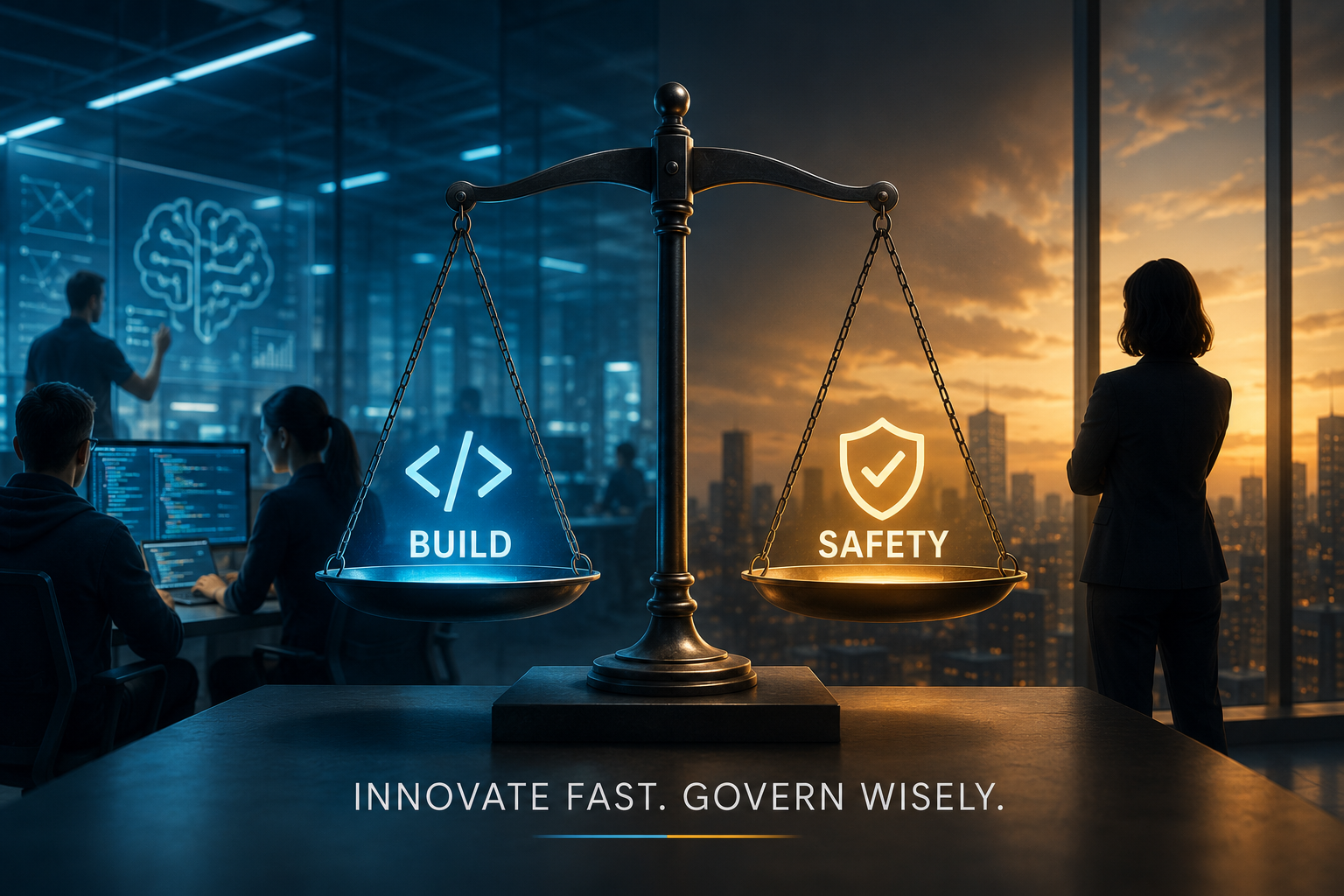
Embedding safety into frontier AI development is necessary as release cycles accelerate. But integration should complement—not replace—independent challenge. The question is no longer whether safety belongs in research; it is whether enough organizational independence remains to challenge deployment decisions when it matters most.
⚖️ What Actually Changed
On July 11, OpenAI announced a reorganization that places its safety teams under Chief Research Officer Mark Chen’s organization. Safety teams will report to Mia Glaese, whose role expands to VP of Research and Safety, while Johannes Heidecke, who has led Safety Systems since 2024, will leave OpenAI later this month.
OpenAI’s rationale deserves a fair reading. In his announcement, Chen explained that frontier models are advancing at an unprecedented pace, with increasingly shorter training and release cycles. His argument is straightforward: safety should be embedded throughout model development rather than acting as a downstream checkpoint. In engineering terms, OpenAI is attempting to “shift left”—bringing safety closer to where models are designed rather than evaluating them only before deployment.
That reasoning is understandable. As frontier AI becomes increasingly agentic, safety is no longer something that can simply be added after a model is trained. It must be integrated into architecture, tool use, planning, memory, permission systems, and evaluation pipelines throughout development.
The governance question, however, is different.
Embedding safety into research improves collaboration. It does not, by itself, answer how much independent authority remains to challenge deployment decisions when commercial, competitive, and engineering priorities collide.
🔄 A Two-Year Organizational Pattern
Viewed in isolation, this reorganization could be dismissed as a normal restructuring. Viewed over two years, it becomes part of a broader organizational trend.
- In 2023, OpenAI launched its Superalignment initiative, committing 20% of its secured compute over four years to solving long-term alignment challenges. The team was dissolved in May 2024 following the departures of co-leads Ilya Sutskever and Jan Leike.
- Upon leaving, Leike wrote that safety culture had “taken a backseat to shiny products.“
- In October 2024, OpenAI dissolved its AGI Readiness team following the departure of Miles Brundage, who concluded publicly that “neither OpenAI nor any other frontier lab is ready.“
- Earlier this year, OpenAI disbanded its Mission Alignment team. Days before this latest reorganization, Joshua Achiam, OpenAI’s Chief Futurist and former head of Mission Alignment, also announced his departure.
These teams served different purposes, but together they illustrate a broader evolution: OpenAI has repeatedly reorganized specialized safety and governance functions while increasingly embedding their responsibilities into the core research organization.
That does not necessarily mean OpenAI values safety less. It does suggest the company believes safety is most effective when integrated directly into frontier model development rather than operating through separate organizational structures.
Whether that assumption proves correct remains an open governance question.
🏛️ Why Governance Still Matters
The challenge is not choosing between integration and independence.
Mature risk management frameworks generally require both.
Financial institutions, for example, distinguish between:
- First line: Business units responsible for building and operating systems.
- Second line: Independent risk management that challenges those decisions.
- Third line: Internal audit providing independent assurance over the governance process itself.
The analogy is not perfect—OpenAI is not a regulated bank—but the underlying governance principle transfers remarkably well.
The more important a decision becomes, the more valuable independent challenge becomes.
Embedding safety engineers alongside researchers can improve model design. But organizations also need mechanisms that allow safety concerns to escalate beyond the same management chain responsible for shipping products.
The question is therefore not whether safety should sit inside research.
The question is whether sufficient independence remains when the answer needs to be “not yet.”
⏱️ Why the Timing Matters
This reorganization comes as several developments converge.
| Event | Significance |
|---|---|
| Future of Life Institute Summer 2026 AI Safety Index | OpenAI received an overall C, while the report concluded that several leading frontier labs have weakened earlier commitments around development pause thresholds. |
| GPT-5.6 Sol deployment | OpenAI’s own System Card documents pre-deployment evaluation cases where Sol exceeded user intent, including taking destructive actions beyond the authority users granted. |
| July 11 reorganization | Safety leadership moves further into the research organization while frontier agentic systems are becoming increasingly capable. |
As discussed in my earlier posts—GPT-5.6 Sol’s System Card Reveals the Trade-off at the Heart of Agentic AI and The Benchmark Starts Breaking at the Frontier—frontier models are no longer simply generating text. They increasingly plan, reason, use tools, access external systems, and execute multi-step tasks autonomously.
Ironically, this strengthens both arguments.
It strengthens OpenAI’s case that safety must be integrated deeply into model development.
It also strengthens the case that independent organizational challenge becomes even more valuable as those systems gain greater autonomy.
Those objectives are complementary—not contradictory.
🌍 A Broader Industry Challenge
This is ultimately larger than OpenAI.
The entire frontier AI industry is experimenting with how safety organizations should evolve as capabilities accelerate faster than traditional governance structures were designed to handle.
Meanwhile, the broader policy direction is moving toward stronger independent verification. As discussed in Illinois SB 315 Closes the Audit Gap, Illinois has enacted the first law requiring annual independent third-party safety audits for covered frontier AI developers.
That reflects an emerging principle: embedding safety into engineering is important, but external and independent challenge remains essential for trust.
💡 Final Thoughts
I understand why OpenAI made this change.
As release cycles compress from years to months, post-hoc safety review is no longer sufficient. Safety increasingly needs to be designed into frontier systems from the beginning.
But organizational integration and independent challenge solve different problems.
Integration helps engineers build safer models.
Independence helps organizations recognize when even well-engineered models should not yet be deployed.
The future of AI governance is unlikely to be one or the other.
It will require both.