The Victory Athens Could Not Keep: Arginusae and the Redistribution of Order
Arginusae suggests that human order is not a single quantity. Military effectiveness, democratic accountability, religious obligation, legal procedure, and political stability can all represent different forms of order—and strengthening one can weaken another. What looks like success may therefore depend on where we draw the boundary of the system.
⚓ Another Athenian Experiment in Order
I recently wrote about Athens’ extraordinary experiment with ostracism—a mechanism created to prevent excessive political power from accumulating in a single individual.
What interested me was not simply that ostracism eventually stopped being used.
It was what happened to the order the institution had created.
Political ambition did not disappear. Political factions gradually adapted to the mechanism intended to constrain them. By the final ostracism, rival leaders could coordinate their followers and redirect the institution against someone else.
I described this as a redistribution of order.
Athens created an institution. The institution changed incentives. People adapted to those incentives. Eventually, the surrounding political system reorganized itself around the institution.
Another episode in Athenian history makes me wonder whether that idea goes further.
The Battle of Arginusae in 406 BCE presents a different problem.
Here, order was not simply redistributed because people adapted to an institution.
Instead, different forms of order collided with one another.
Military effectiveness.
Democratic accountability.
Religious obligation.
Legal procedure.
Public grief.
Political stability.
All were legitimate parts of the same society.
And Athens discovered that preserving one did not necessarily preserve the others.
⚔️ The Order Athens Created at Sea
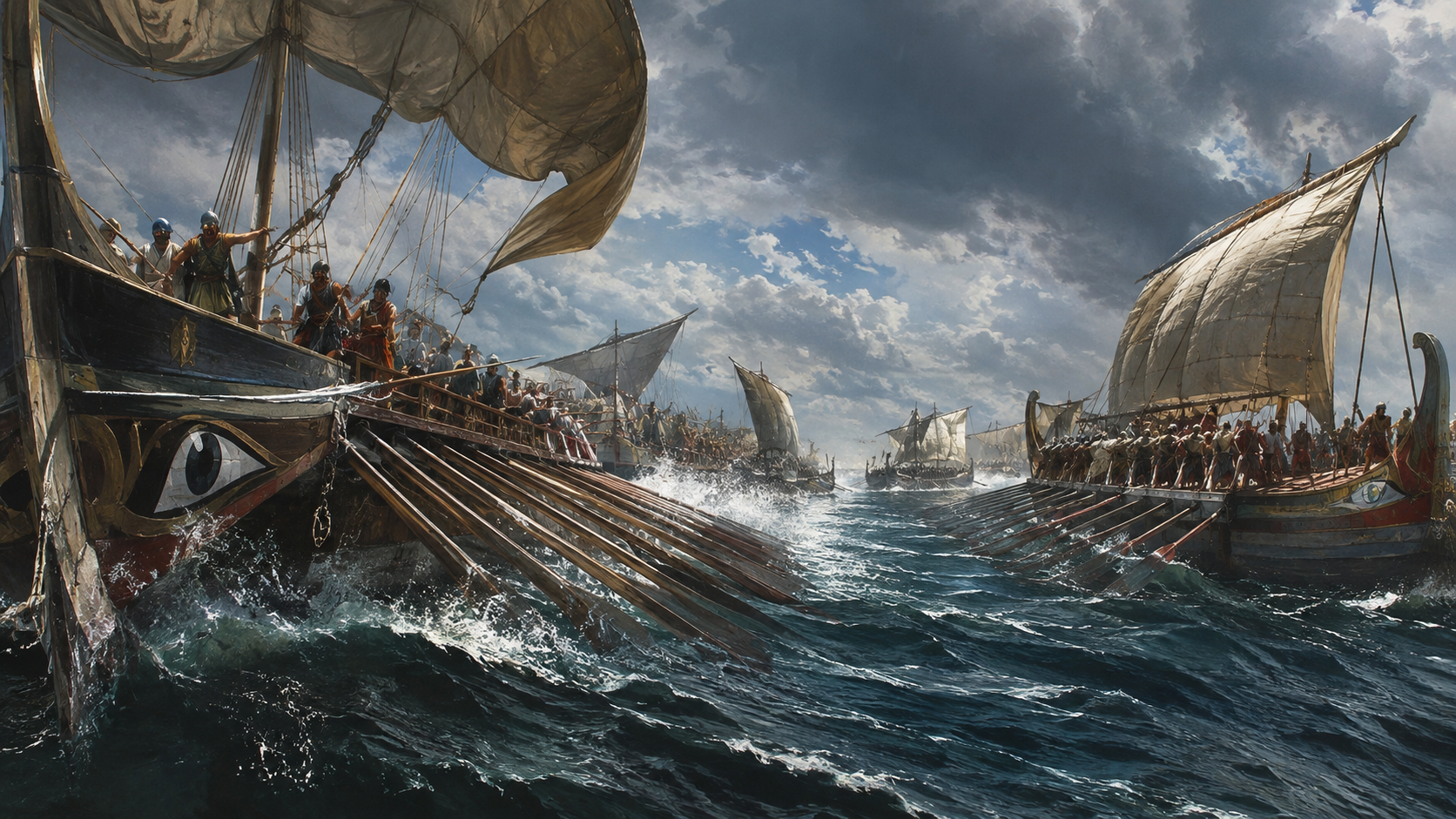
In the summer of 406 BCE, Athens achieved a remarkable military victory.
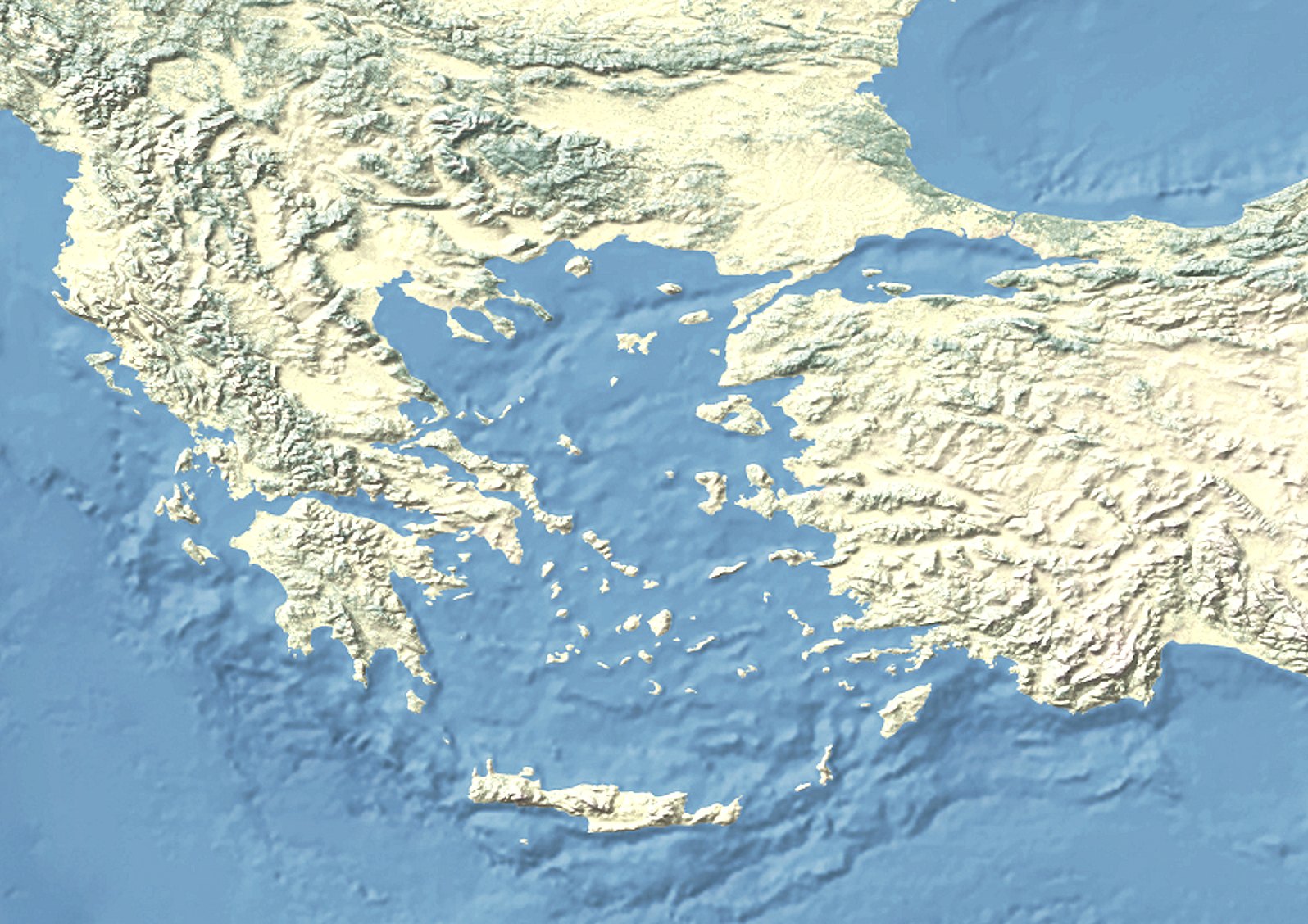
Its fleet defeated Sparta near the Arginusae Islands, east of Lesbos. Nearly three hundred ships were involved, making it one of the largest naval battles the Greek world had yet seen. The Spartan commander Callicratidas was killed, and the Spartans lost roughly seventy ships.
For an Athens exhausted by more than two decades of the Peloponnesian War, this was an extraordinary creation of military order.
Ships had to be built.
Money raised.
Crews assembled.
Thousands of rowers coordinated.
Command structures established.
Tactics executed across a chaotic battlefield.
Athens converted timber, money, human bodies, experience, discipline, and risk into organized military power.
And that organization produced victory.
Yet the same battle produced something else.
A number of Athenian ships had been disabled. Sailors remained in the water. The commanders arranged for a rescue effort while the main fleet pursued the enemy, but according to Xenophon’s Hellenica, a severe storm prevented the rescue operation from succeeding.
Many men were lost.
Their bodies could not be recovered.
Athens had won.
But something about that simple sentence now seems incomplete to me.
🌊 The Part of Victory That Did Not Come Home
The failure to rescue the sailors was not merely an operational problem.
Families had lost sons, fathers, brothers, and husbands. Some of the dead had not received proper burial, an issue carrying profound religious and social significance in the Greek world.
Military victory therefore existed alongside something that looked very different from another part of the system.
From the perspective of the battle:
Athens won.
Expand the boundary slightly:
Athens won, but the rescue operation ended disastrously.
Expand it again:
Athens won, sailors died, families grieved, religious obligations went unmet, and responsibility had to be assigned.
The historical event has not changed.
Only the boundary around what we choose to observe has changed.
This is where the story reconnects, at least metaphorically, with my earlier reflections on entropy.
The Second Law of Thermodynamics does not say that local order cannot increase. It says that the entropy accounting has to work across the larger physical system.
History is obviously not thermodynamics. There is no equation allowing us to add military order and subtract political disorder.
But the analogy makes me ask a question I did not previously ask:
When we observe an extraordinary creation of order, how large a system must we examine before we understand what it actually cost?
⚖️ Athens Tried to Restore Another Kind of Order
Six of the eight generals involved eventually returned to Athens.
What followed became one of the most controversial episodes in Athenian democratic history.
The politician Callixenus proposed that the Assembly judge the generals collectively rather than through separate proceedings. According to Xenophon, opponents challenged the legality of the procedure.
When some of the prytaneis resisted putting the proposal to a vote, members of the crowd threatened them with prosecution.
Eventually, almost everyone yielded.
One did not.
Socrates, then serving on the Council, refused to act contrary to the law. Plato later recalled the episode in the Apology, presenting Socrates as willing to face political danger rather than participate in an unlawful collective proceeding.
Euryptolemus argued that the generals should receive separate trials and proper opportunities to defend themselves. His proposal briefly prevailed before another procedural vote reversed the result.
The generals were condemned collectively.
The six who had returned—Pericles the Younger, Diomedon, Lysias, Aristocrates, Thrasyllus, and Erasinides—were executed.
Athens had attempted to restore one form of order.
Accountability.
But in doing so, it damaged others.
Legal procedure.
Military expertise.
Institutional restraint.
Perhaps even confidence in democratic judgment itself.
🔄 Order Is Not One Thing
Arginusae presents something more difficult than ostracism did.
There was no single “order” to preserve.
Athens wanted military effectiveness, democratic accountability, respect for religious obligation toward the dead, citizen sovereignty over commanders, lawful procedure, and experienced leadership for an existential war.
Each was a form of order.
Under the conditions of 406 BCE, Athens could not maximize all of them at once.
That makes me increasingly uncomfortable with the simple distinction between order and disorder when thinking about human systems.
Perhaps human order is multidimensional.
Strengthening one form can weaken another.
A highly efficient company may become less resilient.
A society maximizing security may sacrifice freedom.
A career can become extraordinarily ordered while a family becomes increasingly unstable.
Artificial intelligence may dramatically increase cognitive productivity while forcing labor markets, education, regulation, and even our understanding of human expertise to reorganize around it.
None of these examples means that the newly created order is “bad.”
It means that local order tells us surprisingly little about the state of the larger system.
🏛️ Two Athenian Stories, Two Different Movements
This is why I now see Arginusae and ostracism as two related but distinct historical experiments.
In the ostracism story, order changed the incentives around it.
The institution constrained power.
Political actors adapted.
Power reorganized itself around the institution.
At Arginusae, something different happened. Military order produced victory, victory produced grief, and the attempt to answer that grief damaged a different kind of order altogether.
The first story is about adaptation around order.
The second is about competition between orders.
Perhaps both belong to a larger pattern:
Creating order does not end a process. It changes the system in which the next process begins.
🌐 Where Is the System Boundary?
This may be the question I find most difficult.
Suppose I clean my house.
I create obvious local order.
But the garbage has not disappeared.
I moved it outside.
From the perspective of my living room, the problem is solved.
From the perspective of my house, perhaps it is solved too.
From the perspective of the landfill, something very different happened.
Thermodynamics handles this by defining system boundaries carefully.
Life and history rarely give us that luxury.
What was the relevant system at Arginusae?
The battle?
The fleet?
The families of the dead?
Athenian democracy?
The Peloponnesian War?
Athens itself?
The Greek world?
Changing the boundary changes what looks like success. A victory, a catastrophe, a demand for accountability satisfied, and a legal safeguard violated can all be true of the same week.
Perhaps many contradictions in how we judge history—and life—arise because we are measuring different forms of order across different system boundaries.
🌊 We Participate in More Order Than We Create
There is another connection with something I have been thinking about more broadly.
We tend to describe historical actors as if they were independently creating events.
But very few people at Arginusae designed the system in which they acted.
The sailors inherited the war.
The generals inherited Athenian military institutions.
The Assembly inherited democratic procedures.
Socrates inherited laws he believed himself obligated to follow.
The grieving families inherited religious expectations surrounding burial.
Even Callixenus operated within political incentives he did not invent.
Everyone exercised some agency.
Yet everyone was also being carried by structures much larger than themselves.
Perhaps this is true of our own lives more often than we acknowledge.
We inherit language, culture, markets, law, morality, technology, geopolitics, and social expectations.
Most of the time, we are not creating order from nothing. We are participating in a much larger redistribution already underway.
Occasionally, however, we have more meaningful choices — whom we marry, what career we pursue, whether we start a company, how we raise a child, what technologies we build.
Even these decisions are never completely independent of the systems around us, but our agency may be greater.
Perhaps the distinction matters.
When we are mostly participants in a larger movement, understanding the direction of that movement may be more important than pretending we control it.
When we genuinely have the ability to create a new order, perhaps greater caution is warranted—because we rarely understand in advance what surrounding orders will have to adjust.
There is no clean boundary between those situations.
Most of life probably contains both.
⏳ The Order Athens Could Not Keep
The Athenians themselves soon regretted the executions. Xenophon records that they later moved against those believed to have deceived the people.
But remorse could not restore the generals.
A year later, Athens suffered its catastrophic defeat at Aegospotami. Lysander destroyed most of the Athenian fleet, and Athens soon lost the war.
It would be far too simple to say that Arginusae caused Aegospotami.
History rarely provides such clean causal chains.
The more interesting sequence is internal to Athens itself.
A military system produced victory.
The victory came with casualties.
The casualties produced grief.
Grief entered politics.
Politics overwhelmed procedure.
The attempt to restore accountability eliminated experienced commanders.
The system ended with a different distribution of order than the one with which it began.
I do not think thermodynamics explains any of this.
Entropy is not a theory of politics, morality, or history.
But the Second Law has given me a metaphor that keeps generating questions.
My earlier reflection on ostracism led me to think that order does not necessarily disappear; it may be redistributed as people adapt around it.
Arginusae makes me add something else:
There may never have been a single order to begin with.
Human systems contain many overlapping orders—legal, political, economic, familial, technological, moral—and they do not necessarily move together.
What looks like greater order from one perspective may look like greater disorder from another.
And perhaps that is why the question of the system boundary matters so much.
Victory for whom?
Order where?
Cost paid by whom?
And over what period of time?
I still do not know how far the entropy analogy can legitimately be taken.
Perhaps not very far scientifically.
But as a way of looking at history—and increasingly at life—I find it useful precisely because it discourages me from looking only at the beautiful order directly in front of me.
Whenever something remarkable has been created, perhaps the next question should be:
What else in the surrounding system had to move—and how long will it take before we see where it went?