The White House Accuses Moonshot AI: The Kimi K3 Distillation Dispute Opens a New Front in U.S.-China AI Competition
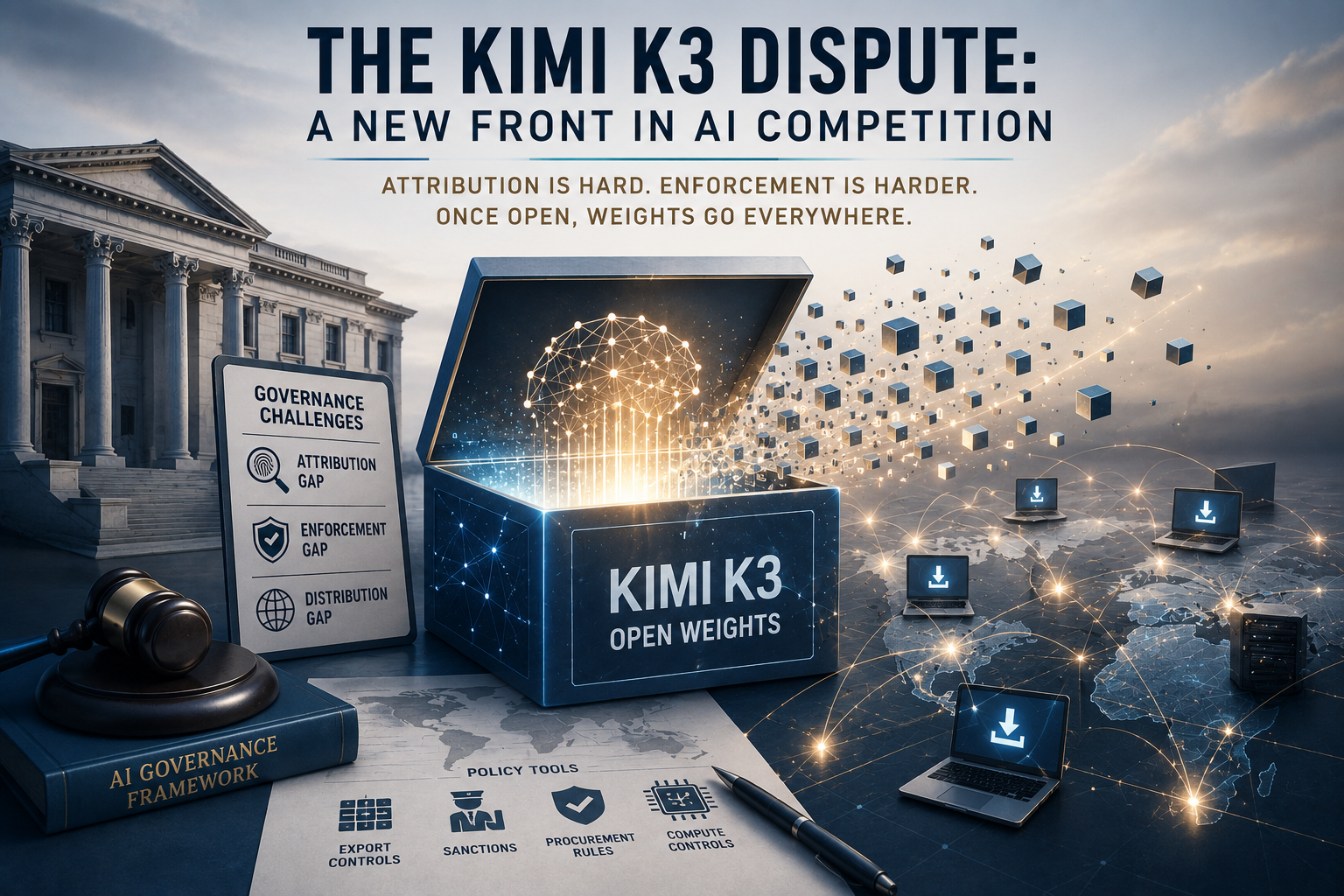
The White House's accusation against Moonshot is more than a dispute over one model—it exposes a structural governance mismatch. Existing policy tools are increasingly effective at regulating chips, companies, and cloud infrastructure, but far less prepared to govern model lineage, synthetic knowledge transfer, and globally distributed open weights.
🚨 What Makes Kimi K3 Significant Enough to Name
On July 22, White House Office of Science and Technology Policy (OSTP) Director Michael Kratsios publicly accused Moonshot AI of conducting large-scale, covert distillation of Anthropic’s Claude models to develop Kimi K3—one of the clearest instances to date in which a senior U.S. official has linked a named Chinese AI laboratory to the alleged copying of a named American frontier model. Treasury Secretary Scott Bessent later warned that sanctions and Commerce Department Entity List actions could be considered against companies engaged in large-scale distillation of American AI systems.
The accusation represents a meaningful escalation in U.S. AI policy. Previous debates largely focused on export controls and semiconductor access. This time, the public focus shifted to knowledge transfer itself—specifically, whether frontier capabilities can be replicated through large-scale API-based distillation rather than independently developed.
Moonshot released Kimi K3 on July 16 as a 2.8-trillion-parameter sparse Mixture-of-Experts (MoE) model with 104 billion active parameters, a 1-million-token context window, and native multimodal capabilities. It is arguably the largest open-weight model released to date by total parameter count. Benchmarks published by Moonshot and independent evaluations place it among the strongest publicly available models, particularly for coding and agentic workloads, although the strongest proprietary models still lead in several areas.
For Washington, that performance—not merely the model’s size—is what makes the allegation consequential.
Anthropic had already laid part of the foundation months earlier. In February 2026, the company disclosed that it had attributed more than 3.4 million Claude conversations to Moonshot through hundreds of fraudulent accounts allegedly created to collect large volumes of synthetic training data spanning coding, reasoning, vision, and agentic capabilities. Kratsios also alleged that Moonshot obtained or accessed Nvidia GB300 systems through overseas infrastructure, potentially circumventing U.S. export controls.
🔬 The Public Technical Case Is Less Conclusive Than the Official Attribution
Although the policy rhetoric has escalated rapidly, the public technical evidence remains far less definitive.
Claude Fable 5 became broadly available again on July 1, while Kimi K3 launched only 15 days later. That timeline prompted researchers to question whether K3 could realistically have been trained primarily from Fable 5 outputs during such a short window.
Independent behavioral testing has also produced intriguing—but not conclusive—signals. Redwood Research Chief Scientist Ryan Greenblatt observed that K3 disproportionately identifies itself as Claude when questioned about its identity, occasionally referring to itself as Claude 4.5. Similar identity confusion has appeared in previous Kimi releases. Such behavior is certainly consistent with training on Claude-generated outputs, but it is not a reliable forensic test. Shared datasets, synthetic training data, imitation prompts, or other post-training techniques could produce similar effects.
That distinction matters.
Anthropic’s February disclosure provides substantial evidence that Moonshot conducted a large-scale campaign to collect Claude outputs. It does not, by itself, publicly prove that Kimi K3 was specifically distilled from Claude Fable 5.
The White House may possess classified intelligence or additional evidence that has not been released publicly. But from the perspective of outside researchers, investors, and enterprises, the evidentiary standard remains unsettled.
The core challenge is not whether distillation is technically possible—it clearly is. The challenge is that no widely accepted technical or legal standard yet exists for proving model lineage with enforcement-grade confidence.
⚖️ The Governance Gap Is Bigger Than One Company
The Moonshot dispute exposes a broader governance problem that extends well beyond this individual case.
Today’s policy toolkit is built largely around regulating tangible assets:
- advanced semiconductors,
- cloud infrastructure,
- exports,
- corporate entities,
- financial transactions.
Those are areas where governments possess mature legal authorities and decades of enforcement experience.
Frontier AI, however, increasingly consists of intangible assets:
- model weights,
- synthetic knowledge,
- learned capabilities,
- generated training data.
Those behave much more like software or information than traditional industrial products.
That creates three interconnected governance gaps.
| Governance Gap | Why It Matters |
|---|---|
| Attribution | Distillation can be suspected through behavioral analysis, API records, or statistical comparisons, but no widely accepted technical or legal standard exists for proving model lineage. |
| Enforcement | Even if unlawful distillation is established, sanctions and export controls primarily affect future compute, infrastructure, and commercial activity—they cannot undo a model that has already been trained. |
| Distribution | Once open weights are globally mirrored, governance shifts from controlling access to regulating the ecosystem surrounding the model rather than the model itself. |
The Moonshot controversy therefore illustrates something larger than an accusation against a single Chinese company.
It reveals that AI governance is gradually moving away from regulating hardware toward regulating knowledge itself.
💻 Open Weights Change the Nature of Governance
As discussed in The Government Just Killed Two Frontier Models Overnight and After the Shutdown, the U.S. has demonstrated that it can meaningfully influence access to frontier AI through export controls, commercial licensing, and API-based distribution.
Open-weight models present a fundamentally different governance challenge.
Consider a familiar analogy.
Imagine Microsoft offered Windows exclusively as a cloud service. Microsoft could suspend accounts, revoke access, enforce licensing terms, and monitor usage. Governments could also influence distribution through procurement policies, sanctions, and commercial restrictions.
Now imagine Microsoft instead published the complete Windows source code for anyone to download, copy, modify, and run locally.
Authorities could still regulate commercial deployment, government procurement, cloud hosting, and business transactions involving the software. But eliminating every copy—or preventing future redistribution—would become practically impossible.
Open-weight frontier models create a similar shift.
Once Kimi K3’s weights were released publicly on July 27, they ceased to be merely a hosted service. They became information.
Governments can still regulate the surrounding ecosystem: cloud providers, commercial deployments, procurement, exports, financial transactions, and supporting infrastructure. Those remain meaningful policy tools.
What becomes dramatically harder is recalling every copy or preventing local execution once the weights have propagated across mirrors, research institutions, and private infrastructure worldwide.
That distinction may prove to be the most enduring lesson from the Kimi K3 controversy.
The issue is not simply whether Moonshot copied Anthropic.
The issue is that modern AI governance has become increasingly effective at governing compute and companies, while remaining comparatively immature at governing model lineage, synthetic knowledge transfer, and globally distributed model weights.
Regardless of how the Moonshot allegations ultimately unfold, that governance mismatch is likely to shape the next phase of U.S.-China AI competition far more than this single dispute alone.