The Dinner That Bought the Constitution Time
Durable institutions do not eliminate opposing forces. They contain them, balance them, and give them controlled ways to act against one another. Institutional entropy begins when that tension either disappears or escapes its boundaries.
Around June 20, 1790, Alexander Hamilton stood outside the President’s House in New York looking, in Thomas Jefferson’s later words, “somber, haggard, and dejected beyond description.” His proposal for the federal government to assume the states’ Revolutionary War debts — a centerpiece of his financial program — had been defeated in the House, leaving the broader funding system in jeopardy. Jefferson, newly arrived as Secretary of State and by his own account not yet steeped in the details, found Hamilton near the President’s door and asked what was wrong.
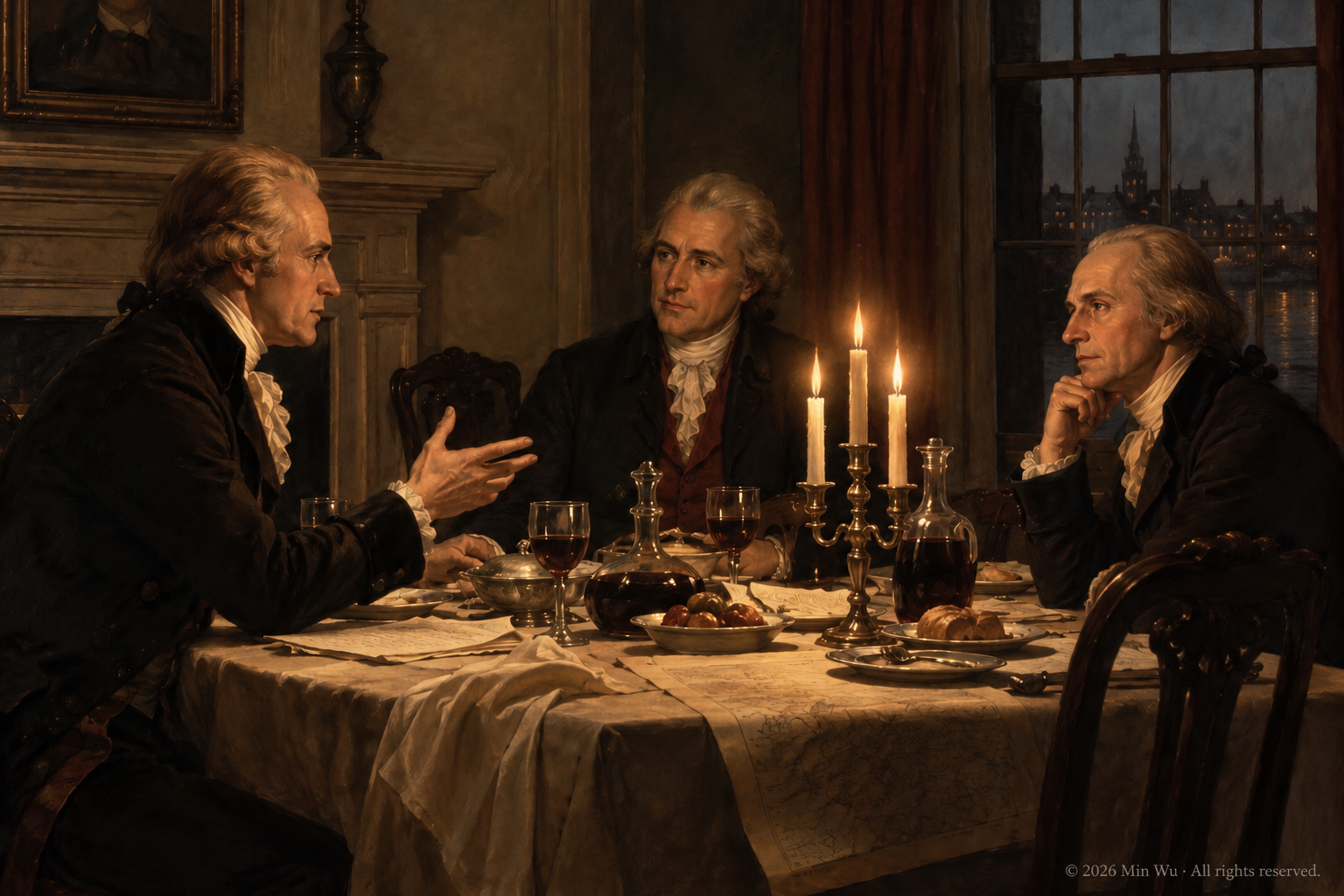
Jefferson invited Hamilton to dinner and also invited Hamilton’s chief opponent on assumption: James Madison.
The three men had history. Hamilton and Madison had written the Federalist essays together only a few years earlier. But now they stood on opposite sides of a dispute touching two questions that threatened to divide the young republic: who would bear the Revolutionary debt, and where the permanent capital would sit.
What happened at the table is known mostly from Jefferson’s account, written roughly two years later.
By his telling, the men worked out that assumption would return before the House “by way of amendment from the Senate.” Madison would not vote for it or entirely abandon his opposition, but he would cease pressing the fight as aggressively and speak with several colleagues about accepting a modified version. Hamilton, meanwhile, would use his influence with northern members to support locating the permanent capital on the Potomac, with Philadelphia serving as the temporary capital for ten years.
As Jefferson put it, “It was observed … that as the pill [of debt assumption] would be a bitter one to the Southern states, something should be done to soothe them.”
The eventual assumption package was also modified in ways favorable to Virginia, reducing the mismatch Madison had objected to between what Virginia would contribute and what would be assumed on its behalf.
The Residence Act passed the House on July 9 by 32 votes to 29. On July 26, the House approved the assumption provision 34 to 28. Four representatives from states bordering the Potomac — two from Virginia and two from Maryland — switched to support assumption. The larger Funding Act became law on August 4.
Two political problems that had appeared stuck suddenly moved.
But the famous dinner is not quite as tidy as the legend.
Negotiations over the capital’s location had been underway before Jefferson set the table. Pennsylvania and Virginia politicians had already been discussing a Philadelphia-to-Potomac arrangement. Other intermediaries had attempted similar bargains. Madison himself continued publicly criticizing assumption after the dinner.
The documentary record therefore cannot tell us that three men sat down one evening and single-handedly determined both outcomes. Jefferson also wrote his account retrospectively, partly while explaining a bargain he later regretted.
The better reading, reflected in the First Federal Congress documentary record, is more interesting: the dinner was one important node in a wider network of bargaining that helped break a genuine political logjam.
It may have been less the origin of the compromise than the moment when several already-moving negotiations finally became linkable.
⚖️ Two Losing Propositions Can Make One Winning Bargain
That distinction matters because the deeper lesson of 1790 is not that three brilliant men solved America’s problems over wine.
Hamilton and Madison did not resolve their disagreement.
Madison still feared the consolidation of federal power. Hamilton still believed assumption was essential to building a coherent national credit system. Southerners did not suddenly love assumption, and northerners did not suddenly discover an affection for the Potomac.
Instead, the structure of the choice changed.
Assumption by itself created one coalition of winners and losers. The capital question created another.
Link them together, however, and politicians who could not accept either outcome independently could tolerate the combined package.
Two losing propositions can sometimes form one winning bargain.
This is usually called logrolling, issue linkage, or political side-payment. It often looks inelegant because it is. But the apparent ugliness can perform an important institutional function: it converts an absolute conflict into a negotiable one.
The disagreement survives.
The deadlock does not.
⚖️ Ambition Counteracting Ambition
There is an irony here.
Only two years earlier, Madison had helped articulate one of the central principles of the new constitutional architecture.
In Federalist No. 51, he wrote that “ambition must be made to counteract ambition”.
The idea was not that good institutions would eliminate competing interests. It was almost the opposite.
Power should encounter power.
The legislature would constrain the executive. Two chambers would constrain one another. Federal and state governments would possess competing jurisdictions. Different constituencies and ambitions would make domination harder.
From the perspective of pure efficiency, this looks terrible.
Checks and balances create friction.
But the friction is partly the point.
A system with one dominant force can produce positive feedback:
Power → more power → fewer constraints → still more power
A counterbalanced system attempts to introduce negative feedback:
Power → resistance → adjustment → temporary equilibrium
And in 1790, Madison was no longer merely theorizing about that mechanism.
He had become part of it.
Hamilton pushed toward stronger federal fiscal capacity. Madison pushed against excessive consolidation. Neither eliminated the other. Their opposition instead revealed where the political system was under stress — and forced both sides to search for another configuration.
⚖️ Keeping Opposition Inside the System
This suggests something deeper than the familiar language of compromise.
A durable political order may depend not merely on tolerating opposition, but on keeping opposition inside the system.
There is a famous line from The Godfather Part II: “Keep your friends close, but your enemies closer.”
Institutions require a slightly different version:
Keep your opposition close enough that it can still constrain you — and close enough that you can still bargain with it.
Hamilton did not need Madison to disappear.
Madison did not need Hamilton to disappear.
Each needed the other to remain an opponent whose interests had to be accounted for.
There is an older philosophical echo here too. The Chinese idea of 阴阳 (yin–yang) treats opposing forces not simply as things one must defeat, but as forces whose interaction can constitute a larger, dynamic order. The Analects offers an even sharper formulation: 和而不同 — harmony without uniformity.
Harmony does not require sameness.
The traditions are very different, but the structural insight is similar: durable order need not eliminate contradiction. It can preserve opposing forces within a relationship in which each constrains, informs, and adjusts to the other. Stability, in this sense, is not stillness. It is continuous rebalancing.
That is fundamentally different from a system in which opposition is suppressed, or one in which rulers manufacture internal or external enemies that can be mobilized without genuinely constraining those who hold power.
A real counterbalance pushes back.
Managed opposition ultimately points in one direction.
The distinction is between:
Power A ⇄ Power B
and:
Power → controls A versus B
Only the first creates meaningful feedback on power itself.
⚖️ Institutional Entropy Is Not Disorder
This connects the dinner to a pattern explored in two earlier pieces on this site.
In The Victory Athens Could Not Keep, Athens did not simply descend into chaos after Arginusae. Under extreme pressure, one political mechanism overwhelmed the constraints that normally bounded it. Democratic authority remained — but the system temporarily lost its ability to regulate how that authority operated.
In The Death List That Wore a Legal Face, Rome’s deterioration was stranger still. Political violence became standardized, published, incentivized, and administratively reproducible.
The system became more organized while becoming less capable of preserving the order it existed to serve.
The dinner of 1790 shows the opposite process.
Conflict → bargaining → adjustment → order
Athens at Arginusae shows a feedback mechanism failing:
Crisis → constraints overwhelmed → irreversible decision → institutional damage
Sulla shows the destructive mechanism itself becoming institutionalized:
Conflict → violence → standardization → reproducible disorder
The difference is not conflict versus peace.
All three systems contained conflict.
The difference is whether institutions can convert conflict into bounded change.
⚖️ The Dinner Bought Time
That may be the real significance of Jefferson’s dinner.
It did not resolve America’s sectional disagreements. It did not make Hamilton and Madison ideological allies. It certainly did not eliminate the forces that would later tear the country apart.
It did something more modest.
It kept disagreement governable.
The Constitution supplied the formal machinery — elections, Congress, taxation, federalism, separated powers. But constitutional text could not specify how Virginia’s objections to debt assumption should be reconciled with Pennsylvania’s ambitions, northern financial interests, or the location of a future capital.
Political bargaining supplied what formal architecture could not.
That is why durable institutions often look frustratingly inefficient from the outside. They contain vetoes, competing jurisdictions, negotiations, procedural delays, concessions, exemptions, and compromises.
Some of that friction is dysfunction.
But some of it is the mechanism preventing disagreement from becoming rupture.
Institutional order is not the absence of opposing forces. It is the capacity to keep those forces bounded, counterbalanced, and capable of producing change without destroying the system that contains them.
The dinner did not settle America’s conflicts.
It bought the Constitution time to keep processing them.